Jeep Wrangler Breakover Angle: What It Means and Why It Matters Off-Road
If you spend time on rocky trails, steep climbs, or uneven terrain, the Jeep Wrangler breakover angle is an important specification to understand. It can make the difference between smoothly cresting an obstacle and dragging the underside of your Jeep across the ground.
Unlike horsepower or towing capacity, breakover angle is a specification that becomes especially important when the trail gets technical. It tells you how steep a ridge or obstacle your Wrangler can pass over without the center of the vehicle contacting the terrain.
But the number isn’t the whole story. Wheelbase, tire size, ground clearance, suspension articulation, vehicle load, and modifications can all affect how your Wrangler performs on an actual trail.
What Is the Jeep Wrangler Breakover Angle?
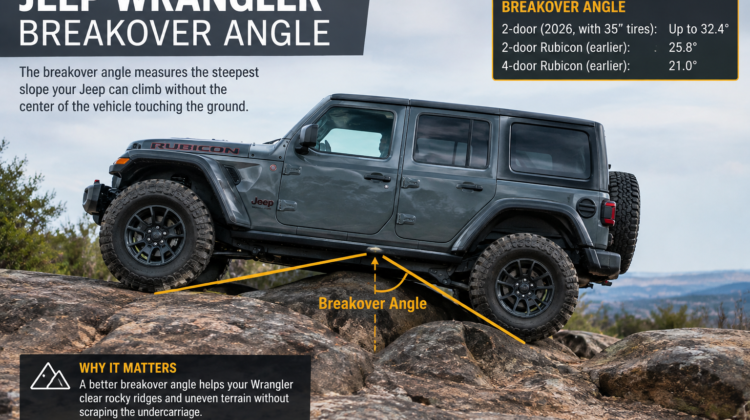
The breakover angle is the maximum angle of a peak or ridge that a vehicle can drive over without the center underside of the vehicle touching the ground.
Jeep itself describes breakover angle as the maximum steepness of a hill or peak that can be crossed without contacting the center of the vehicle.
Think of an obstacle shaped roughly like this:
             /\
            /  \
           /    \
      ____/      \____
          ↑
      Breakover
       angle
As the Wrangler climbs the first side of the obstacle, the front wheels move upward. When the vehicle reaches the peak, the center of the chassis becomes the critical point.
A larger breakover angle generally means the Wrangler can cross a sharper ridge without its belly making contact.
That’s particularly useful when navigating:
- Rocky trails
- Deep ruts
- Sharp drainage crossings
- Steep hill crests
- Uneven ledges
- Off-road obstacles where the front and rear wheels are at different elevations
What Is the Breakover Angle of a Jeep Wrangler?
There isn’t one single breakover-angle number for every Wrangler. The specification varies depending on the model, wheelbase, tires, suspension setup, and other equipment.
For the current 2026 Jeep Wrangler, Jeep says the Wrangler can achieve a breakover angle of up to 32.4 degrees on 2-door models when equipped with available 35-inch tires.
That “up to” figure is important. You shouldn’t assume that every Wrangler has a 32.4-degree breakover angle.
For example, Jeep’s published specifications for earlier Wrangler configurations show how much the angle can vary between 2-door and 4-door versions. A previous factory specification listed 25.8 degrees for the 2-door Rubicon and 21 degrees for the 4-door Rubicon.
The difference is largely related to vehicle geometry, particularly wheelbase.
Quick Reference
| Wrangler configuration | Breakover angle |
|---|---|
| 2026 Wrangler, 2-door with available 35-inch tires | Up to 32.4° |
| Earlier 2-door Rubicon specification | 25.8° |
| Earlier 4-door Rubicon specification | 21° |
Specifications vary by model year and configuration, so always check the factory specifications for the particular Wrangler you’re considering.
Why Does Wheelbase Matter?
One of the biggest factors affecting breakover angle is wheelbase.
Wheelbase is the distance between the front and rear axle centerlines. A longer wheelbase generally makes it harder for a vehicle to crest a sharp obstacle without the middle of the vehicle getting close to the ground.
That’s one reason the shorter 2-door Wrangler can have an advantage on certain technical trails.
Imagine two Wranglers approaching the same sharp ridge. The tires of the shorter vehicle are closer together, while the tires of the longer vehicle are farther apart.
The longer vehicle effectively has to bridge a larger distance over the obstacle.
This doesn’t mean a 4-door Wrangler is poor off-road. Far from it. It simply means vehicle geometry matters, and breakover angle is one of the specifications worth considering when choosing a Wrangler for technical terrain.
Breakover Angle vs. Approach and Departure Angle
It’s easy to confuse the three major off-road angles.
They measure different parts of the vehicle.
1. Approach Angle
The approach angle describes how steep an obstacle the front of the vehicle can approach without the front bumper or another component contacting the ground.
It’s especially important when climbing onto a steep obstacle.
2. Breakover Angle
The breakover angle deals with the center of the vehicle.
It’s most important when the Wrangler reaches the crest of a hill, rock, ridge, or other obstacle.
3. Departure Angle
The departure angle describes how steep an obstacle the rear of the vehicle can leave without the rear bumper or another component hitting the ground.
A simple way to remember them is:
- Approach angle: front of the Jeep
- Breakover angle: middle of the Jeep
- Departure angle: rear of the Jeep
Jeep uses these three measurements as part of its explanation of off-road capability.
How Tire Size Affects Breakover Angle
Tire size can have a noticeable effect on off-road geometry.
Larger tires can increase the distance between the ground and components underneath the Wrangler. They can also change the effective geometry of the vehicle.
That’s why Jeep highlights its available 35-inch tires when discussing the 2026 Wrangler’s maximum breakover capability.
However, installing larger tires doesn’t automatically mean your Wrangler will perform better everywhere.
You also need to consider:
- Tire clearance
- Suspension geometry
- Gearing
- Steering clearance
- Fender clearance
- Tire weight
- Ride quality
- Engine and transmission load
A properly selected tire and suspension combination is generally more useful than simply installing the largest tire possible.
Does Lift Height Improve Breakover Angle?
A suspension lift can increase ground clearance, but more lift doesn’t automatically translate into a proportionally better breakover angle.
This is an important distinction.
Ground clearance and breakover angle are related, but they’re not the same measurement.
A lift can raise the chassis and provide additional clearance underneath the Jeep. However, the overall geometry of the vehicle—including wheelbase and the location of the lowest components—still matters.
A well-designed off-road setup should consider the entire vehicle rather than focusing on lift height alone.
How Suspension Articulation Helps
Breakover angle isn’t the only thing that determines whether a Wrangler can cross an obstacle.
Suspension articulation is also critical.
When one wheel climbs an obstacle, the suspension needs to allow the wheels to move while maintaining traction and keeping the vehicle stable.
The Wrangler Rubicon has an electronically disconnecting front sway bar designed to improve suspension articulation. Jeep says the system allows the front wheels to drop and compress more effectively on difficult terrain.
This is one reason two vehicles with similar basic dimensions can behave differently on a trail.
Geometry tells you what the vehicle can potentially clear, while suspension movement, traction, tires, and driving technique determine how effectively it actually gets through the obstacle.
How to Avoid Dragging the Underside of Your Wrangler
Even with a good Jeep Wrangler breakover angle, you can still contact the terrain if you approach an obstacle incorrectly.
Here are some practical techniques.
1. Approach the Obstacle Slowly
Speed isn’t always your friend on technical terrain.
A slow approach gives you more time to evaluate:
- Where your tires will land
- Where the center of the Jeep will pass
- Whether the obstacle has a sharp peak
- Whether your suspension can articulate over it
2. Look at the Entire Obstacle
Don’t focus only on the front tires.
A Wrangler can clear the front portion of an obstacle and still make contact underneath when the center reaches the peak.
Try to visualize the vehicle’s entire path before committing.
3. Use the Correct Line
Sometimes the easiest way around an obstacle is simply choosing a different line.
Instead of climbing directly over the highest point, you may be able to approach at an angle that allows one tire to climb first and reduces the effective severity of the obstacle.
4. Keep Your Tires Properly Positioned
On technical trails, tire placement matters enormously.
A few inches can determine whether you’re driving over a rock with the tire or dragging the differential, skid plate, or chassis across it.
5. Know What’s Under Your Jeep
Before serious off-roading, familiarize yourself with the location of vulnerable components.
Depending on the Wrangler and modifications, these can include:
- Differential housings
- Exhaust components
- Driveshafts
- Skid plates
- Fuel-system components
- Suspension components
Knowing where the low points are helps you choose better lines.
Does a 2-Door Wrangler Have Better Breakover Capability?
Generally, the shorter-wheelbase 2-door Wrangler has a geometric advantage in breakover situations compared with a longer-wheelbase version.
This is reflected in Jeep’s published specifications for different Wrangler configurations. For example, earlier factory data listed a 25.8-degree breakover angle for the 2-door Rubicon versus 21 degrees for the 4-door Rubicon.
That doesn’t make the 4-door Wrangler unsuitable for difficult trails.
The 4-door configuration offers other advantages, including additional passenger and cargo space, and modern Rubicon models have substantial off-road equipment.
For someone who frequently carries passengers, camping equipment, recovery gear, or other trail equipment, the additional space may be more useful than the geometric advantage of the shorter wheelbase.
What About the Wrangler Rubicon?
The Wrangler Rubicon is designed specifically with serious off-road use in mind.
Depending on configuration and model year, Rubicon equipment can include features such as:
- Rock-Trac 4×4
- 4:1 low-range gearing
- Electronic sway bar disconnect
- Locking differentials
- Rock rails
- Larger off-road tires
Jeep says the 2026 Wrangler Rubicon’s Rock-Trac system uses a 4:1 low gear ratio, while available 35-inch tires contribute to the Wrangler’s maximum off-road geometry.
The result is a Wrangler designed to handle terrain where vehicle geometry, traction, suspension articulation, and low-speed control all matter.
Can You Improve Your Wrangler’s Breakover Angle?
Yes, modifications can change the Wrangler’s off-road geometry.
Common upgrades include:
- Larger tires – Can increase clearance and alter the vehicle’s effective geometry.
- Suspension upgrades – A properly engineered lift can increase clearance underneath the vehicle.
- Skid plates – These don’t necessarily increase the angle itself, but they can help protect vulnerable components when contact occurs.
- Wheel and tire combinations – Proper fitment can improve usable clearance without creating unnecessary handling or clearance problems.
- Suspension articulation upgrades – These can help the Wrangler maintain traction and negotiate uneven terrain.
The key is to build the Jeep as a system. A large lift with poor suspension geometry isn’t necessarily a better off-road setup.
How Do You Measure Breakover Angle?
If you’re evaluating a modified Wrangler, you can estimate its breakover angle using its wheelbase and the available ground clearance at the relevant low point.
In simplified terms, breakover angle is determined by the geometry formed between the tire contact patches and the lowest point underneath the vehicle.
The theoretical calculation can be represented as:
Breakover angle = 2 × arctangent (ground clearance ÷ half the wheelbase)
Real-world measurements can be more complicated because the lowest point may not be exactly in the center of the wheelbase, and tire deformation, suspension movement, vehicle loading, and terrain can change the actual clearance.
For a factory vehicle, the manufacturer’s published specification is usually the better reference.
Is Breakover Angle Important When Buying a Used Wrangler?
Absolutely—especially if you plan to use the Wrangler for serious off-roading.
When comparing used Wranglers, don’t look at breakover angle in isolation. Check the complete configuration.
Pay attention to:
- 2-door vs. 4-door
- Trim level
- Tire size
- Wheel and tire modifications
- Suspension lift
- Skid plates
- Rock rails
- Differential configuration
- Overall condition
- Previous off-road use
A heavily modified Wrangler may have excellent off-road equipment, but it’s also worth inspecting the underside carefully for evidence of hard impacts.
If you’re shopping for your next Jeep, you can browse available Jeeps for sale and compare the specifications and equipment of individual vehicles before making a decision.
Jeep Wrangler Breakover Angle: The Bottom Line
The Jeep Wrangler breakover angle is one of the most useful specifications to understand if you’re serious about off-roading.
It tells you how steep a ridge or peak the Wrangler can cross before the center of the vehicle is likely to contact the terrain.
The important points are:
- A larger breakover angle generally provides better clearance over sharp crests.
- Shorter-wheelbase Wranglers generally have a geometric advantage in breakover situations.
- Larger tires can improve off-road geometry.
- Lift kits can increase clearance but don’t automatically solve every geometry problem.
- Suspension articulation and tire placement are just as important on the trail.
- The published angle varies by Wrangler configuration and model year.
- The 2026 Wrangler can achieve up to 32.4 degrees of breakover angle on 2-door models with available 35-inch tires, according to Jeep.
Ultimately, a good breakover angle is only one part of what makes a Wrangler capable off-road. Tire selection, traction, suspension articulation, ground clearance, driver technique, and choosing the right line all work together.
If you’re comparing Wranglers for your next trail build, look beyond a single specification and evaluate the entire vehicle setup.

Leave a Reply