Jeep Wrangler Backspacing: The Complete Guide to Choosing the Right Wheel Fitment
If you’re shopping for aftermarket wheels for your Jeep Wrangler, Jeep Wrangler backspacing is one measurement you can’t afford to overlook. It can determine whether your new wheels clear the suspension, how far the tires sit outside the fenders, and whether larger tires rub when you turn the steering wheel.
Backspacing can be confusing at first because wheel manufacturers also list offset, and the two measurements are closely related. But once you understand how they work together, choosing wheels for your Wrangler becomes much easier.
Whether you’re building a daily-driven Jeep, an off-road rig, or simply want a more aggressive stance, this guide explains Jeep Wrangler backspacing, how to measure it, how it relates to offset, and what to consider before buying new wheels.
What Is Jeep Wrangler Backspacing?
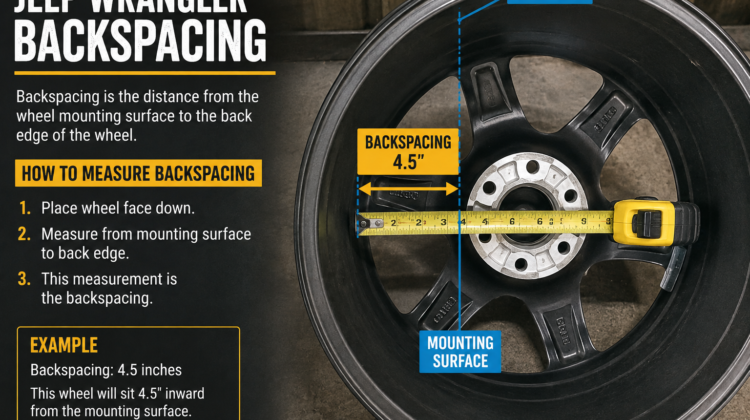
Backspacing is the distance between the wheel’s mounting surface and its inner edge, measured in inches.
In simple terms, it tells you how far the wheel sits inward toward the Jeep’s suspension and brakes.
A wheel with more backspacing positions the wheel farther inward. A wheel with less backspacing moves the wheel outward toward the fender.
That’s important because changing the wheel position can affect clearance between the tire and:
- Control arms
- Steering components
- Shock absorbers
- Brake components
- Sway-bar components
- Inner fender liners
- Outer fenders
Backspacing and offset describe related aspects of wheel position, but backspacing is measured in inches while offset is measured in millimeters.
Why Does Jeep Wrangler Backspacing Matter?
The right backspacing isn’t simply about getting a certain “look.” It can have a direct effect on tire clearance and wheel fitment.
For example, installing a wider tire on a wheel with excessive backspacing can place the tire closer to the suspension. During a turn or suspension articulation, that can lead to rubbing.
On the other hand, reducing backspacing pushes the wheel outward. That can create additional room on the inside, but it also increases tire poke and may introduce clearance issues at the fender.
This is why choosing wheels based only on diameter and bolt pattern isn’t enough.
You need to consider the complete combination:
Wheel diameter + wheel width + backspacing + offset + tire size + suspension + fender configuration
A wheel that fits one Wrangler perfectly may not have the same clearance on another Wrangler with different tires, suspension components, or fenders.
Jeep Wrangler Backspacing vs. Offset
This is where many Jeep owners get confused.
Backspacing measures from the wheel’s mounting surface to the inner wheel lip and is expressed in inches.
Offset measures the position of the wheel’s mounting surface relative to the wheel’s centerline and is expressed in millimeters.
The general relationship is:
- More positive offset = more backspacing
- Less positive or negative offset = less backspacing
- More backspacing = wheel sits farther inward
- Less backspacing = wheel sits farther outward
So, for example, a wheel advertised with 4.5 inches of backspacing will generally sit farther outward than a comparable wheel with 5.5 inches of backspacing, assuming the wheel widths are comparable.
It’s important not to compare backspacing numbers without considering wheel width. A 4.5-inch backspace on an 8-inch wheel is not the same fitment as 4.5 inches on a 10-inch wheel.
How to Measure Wheel Backspacing
If you’re trying to determine the backspacing of a wheel you already own, you can measure it yourself.
You’ll need:
- A flat surface
- A straightedge
- A tape measure or ruler
Follow these steps:
- Remove the wheel from the Jeep.
- Lay the wheel face-down on a flat surface.
- Place a straightedge across the back of the wheel.
- Measure from the wheel’s mounting pad to the straightedge.
- Record the measurement in inches.
That measurement is the wheel’s backspacing. This is essentially the same measurement method used in standard wheel-fitment guidance.
Tip: Don’t accidentally measure from the back of the mounting pad to the outer edge of the tire or wheel face. Backspacing refers specifically to the wheel itself.
What Is the Best Jeep Wrangler Backspacing?
There isn’t one universal backspacing number that works for every Wrangler.
Your ideal setup depends on the Wrangler generation, axle configuration, wheel width, tire size, suspension modifications, and fender setup.
That said, aftermarket Jeep wheels commonly fall into a range where reduced backspacing is used to create additional inner clearance for larger tires.
For example, aftermarket wheels currently marketed for the Wrangler include configurations around 4.5 inches of backspacing, while other applications use approximately 5 inches or more.
Some fitment guidance for JL Wranglers also shows that backspacing requirements can change significantly depending on whether the Jeep is a Rubicon or non-Rubicon and what tire and suspension combination is being used.
A practical rule of thumb
For many modified Wrangler builds:
- Around 5.0–5.5 inches: More tucked-in wheel position
- Around 4.5–5.0 inches: Common range for many aftermarket setups
- Around 4.0–4.5 inches: More outward positioning and additional inner clearance
- Very low backspacing: Aggressive stance but potentially more fender poke and steering-load considerations
These are general guidelines, not guaranteed fitment specifications. Always verify the wheel and tire combination for your specific Wrangler.
Jeep Wrangler JK Backspacing
The 2007–2018 Jeep Wrangler JK has an enormous aftermarket wheel selection, which makes it relatively easy to find different backspacing options.
If you’re upgrading from stock wheels to wider tires, reducing backspacing can help move the tire away from suspension components.
However, don’t choose a wheel simply because the backspacing number looks right.
Consider:
- Your tire width
- Tire diameter
- Wheel width
- Lift height
- Factory or aftermarket control arms
- Fender type
- Steering clearance
- Whether you’re running wheel spacers
A 17×8 wheel and a 17×9 wheel with the same backspacing will not position the tire identically relative to the Jeep.
Jeep Wrangler JL Backspacing
The 2018-and-newer Jeep Wrangler JL also has a wide range of aftermarket wheel options.
JL fitment can vary depending on the trim and axle configuration. Rubicon models, for example, can have different clearance considerations from non-Rubicon models.
Aftermarket wheel manufacturers commonly offer JL-compatible wheels with approximately 4.5-inch backspacing, while other wheels are designed with higher backspacing for different tire and suspension combinations.
If you’re building a JL for 35-inch or 37-inch tires, don’t assume that every wheel advertised as “JL compatible” will automatically provide the clearance you need.
Wheel width and tire size matter just as much as backspacing.
How Backspacing Affects Tire Rubbing
One of the biggest reasons Jeep owners research backspacing is tire rubbing.
Imagine installing a wider tire while keeping a wheel with substantial backspacing. The inner sidewall may move closer to suspension components.
When you turn the steering wheel, the tire can contact:
- Front control arms
- Sway bar
- Inner fender
- Steering components
- Shock or spring components
Reducing backspacing moves the wheel outward and can provide additional inner clearance.
But there’s a trade-off.
Moving the wheel outward can increase the possibility of rubbing the outer fender or fender liner, especially when the suspension compresses.
That’s why “less backspacing is always better” isn’t a good rule.
The goal is balanced clearance, not simply pushing the wheel as far outward as possible.
Does Less Backspacing Make a Jeep Look Better?
That’s subjective, but there’s a reason lower-backspacing wheels are popular among Jeep owners.
Moving the wheel outward creates a wider stance and more visible tire sidewall from the front or rear.
It can give a Wrangler a:
- More aggressive appearance
- Wider stance
- More pronounced tire poke
- Trail-oriented look
However, excessive tire poke isn’t necessarily better.
A wheel that’s too far outward can throw more dirt and debris onto the body, increase exposure of the tire to obstacles, and potentially create clearance problems with the fenders.
For a daily-driven Wrangler, a moderate setup is often more practical than an extremely aggressive stance.
Backspacing and Wheel Spacers
Wheel spacers can effectively change the position of your existing wheels.
For example, adding a spacer moves the wheel outward, effectively reducing the amount of backspacing relative to the hub.
This can sometimes be used to create additional clearance when a factory wheel sits too far inward.
However, wheel spacers aren’t a substitute for properly selected wheels in every situation.
If you’re considering spacers, make sure you understand:
- Spacer thickness
- Hub engagement
- Lug-nut compatibility
- Torque specifications
- Wheel load requirements
- Clearance between the spacer and wheel
- Local laws or inspection requirements
If you’re building a serious off-road Wrangler, selecting an appropriate wheel offset and backspacing from the beginning may be preferable to relying on spacers to correct a poor wheel choice.
How to Choose Backspacing for Larger Tires
Larger tires don’t automatically require a specific backspacing number.
Instead, think about where the tire needs clearance.
A wider tire generally needs more room around the suspension and steering components. Moving the wheel outward can provide additional inner clearance, but you then need to make sure the tire doesn’t contact the outer fender.
For example, aftermarket fitment guidance for JL Wranglers shows different backspacing recommendations depending on tire diameter, fender configuration, and suspension setup.
Before buying wheels for 33-, 35-, or 37-inch tires, check the complete combination rather than shopping by tire size alone.
Common Jeep Wrangler Backspacing Mistakes
1. Choosing wheels based only on appearance
A wheel may look perfect in a product photo but still be wrong for your Jeep.
Always verify fitment before ordering.
2. Ignoring wheel width
Backspacing cannot be evaluated independently of wheel width.
A 4.5-inch backspace on an 8-inch wheel and a 4.5-inch backspace on a 9.5-inch wheel have different overall positions.
3. Assuming all JL or JK wheels fit the same
Even within the same Wrangler generation, trim, axle, brake, suspension, and tire combinations can change the clearance requirements.
4. Focusing only on tire rubbing
You should check both inner and outer clearance.
A wheel can eliminate suspension rubbing while creating fender rubbing.
5. Going too aggressive
Extremely low backspacing can produce substantial tire poke. It may also affect the overall behavior and clearance of the vehicle.
The best wheel setup isn’t necessarily the one with the lowest backspacing.
A Simple Jeep Wheel Fitment Checklist
Before purchasing aftermarket wheels for your Wrangler, check all of these specifications:
- Bolt pattern
- Wheel diameter
- Wheel width
- Backspacing
- Offset
- Center bore
- Wheel load rating
- Brake clearance
- Tire size
- Suspension height
- Fender configuration
- Steering clearance
Don’t rely on a single specification.
A wheel needs to work as part of the entire wheel-and-tire package.
What Backspacing Should I Use for 35-Inch Tires?
There is no single answer for every Wrangler running 35s.
The appropriate backspacing depends on the wheel width, Wrangler generation, axle configuration, suspension, fenders, and exact tire dimensions.
As a general starting point, many aftermarket Wrangler wheels intended for larger tires are available around the 4.5- to 5-inch backspacing range. Current aftermarket fitment examples include 17×8.5 wheels with 4.5-inch backspacing and other wheels around 5.2 inches.
Treat those numbers as a starting point rather than a guaranteed recommendation.
Always verify the exact wheel, tire, and Wrangler combination before purchasing.
What Backspacing Should I Use for 37-Inch Tires?
37-inch tires require even more attention to clearance.
As tire diameter and width increase, clearance becomes increasingly important during steering and suspension articulation. Some JL fitment guidance recommends approximately 4.5–4.7 inches of backspacing for certain Rubicon setups running 37-inch tires, while other configurations may require a different specification.
This illustrates an important point:
There is no universal “37-inch tire backspacing.”
The correct number depends on the complete build.
Backspacing vs. Offset: Which One Should You Shop By?
You may find one wheel manufacturer advertising 4.5-inch backspacing, while another emphasizes -12 mm offset.
Don’t assume the numbers are interchangeable without accounting for wheel width.
When comparing wheels, look at the complete specification:
Wheel diameter × wheel width + offset + backspacing
For example:
17×9, 4.5-inch backspacing, -12 mm offset
is much more useful than simply saying:
17-inch Jeep wheel
The more complete the specification, the easier it is to determine whether the wheel will work with your Wrangler.
Final Thoughts on Jeep Wrangler Backspacing
Understanding Jeep Wrangler backspacing can save you from one of the most frustrating parts of a wheel upgrade: buying an expensive set of wheels only to discover that your tires rub.
Backspacing determines how the wheel sits relative to the Jeep’s suspension and fenders. More backspacing generally moves the wheel inward, while less backspacing moves it outward. But the correct choice depends on much more than that single number.
Before ordering your next set of wheels, consider the wheel width, offset, tire dimensions, Wrangler generation, suspension, fenders, and intended use together.
If you’re currently shopping for your next Wrangler, you can also browse available Jeeps for Sale and compare different models before planning your wheel and tire setup.
The right combination isn’t about choosing the most aggressive number. It’s about finding the right balance of clearance, appearance, performance, and reliability for your particular Jeep.

Leave a Reply