Jeep Gladiator Departure Angle: What It Means for Off-Roading
When you’re taking a pickup truck onto rocky trails, steep descents, or uneven terrain, horsepower and tire size aren’t the only specifications that matter. Jeep Gladiator departure angle is another important measurement because it tells you how steep an obstacle the rear of the truck can clear before the bumper or another rear component makes contact with the ground.
The Gladiator has many of the characteristics that make the Wrangler popular off-road, but its pickup-truck design gives it different proportions. The longer rear section behind the axle affects its departure geometry, making this measurement particularly useful when comparing Gladiator trims or planning modifications.
Whether you’re considering a stock Gladiator for occasional trail driving or building one for serious off-road use, understanding departure angle can help you make better decisions about tires, suspension, bumpers, and trail selection.
What Is a Jeep Gladiator Departure Angle?
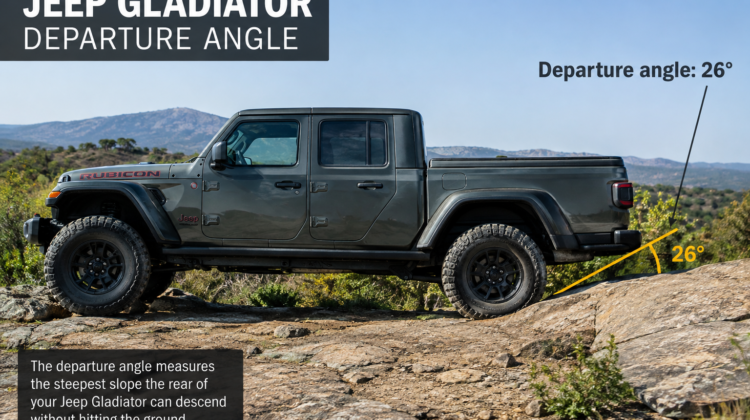
Departure angle is the maximum angle of a slope that a vehicle can descend without the rear of the vehicle contacting the ground.
Think of it this way: you’re driving down a steep ledge. As the front of the Gladiator goes over the obstacle, the rear of the truck eventually follows. If the slope is too steep, the rear bumper, hitch, or another low-mounted component can become the first thing to hit.
A larger departure angle generally means the vehicle can descend steeper obstacles before the rear end makes contact.
Jeep describes departure angle as the rear counterpart to approach angle. Approach angle concerns the front of the vehicle, while departure angle concerns the rear.
Why does it matter?
A good departure angle can help when:
- Descending steep rocky trails
- Driving off ledges or rock steps
- Crossing deep ruts
- Leaving a steep ditch
- Descending from a trail obstacle
- Navigating uneven terrain where the rear suspension compresses
For serious off-road driving, departure angle works together with approach angle, breakover angle, ground clearance, suspension articulation, and tire size.
What Is the Jeep Gladiator Departure Angle?
The exact specification depends on the Gladiator configuration and market.
Jeep’s current Trail Rated information lists the Gladiator Rubicon at 26 degrees of departure angle, along with 11.1 inches of ground clearance.
Jeep’s published Gladiator specifications for other configurations have also listed departure angles around 25 degrees for Sport/Overland models and 26 degrees for the Rubicon, although specifications can vary by model year and market.
| Gladiator configuration | Departure angle |
|---|---|
| Sport / similar configurations | Approximately 25° |
| Rubicon | Approximately 26° |
| Rubicon current Trail Rated specification | 26° |
Always verify the specification for the exact model year and market you’re considering, particularly when comparing used Gladiators from different years.
Why Is the Gladiator’s Departure Angle Lower Than a Wrangler’s?
This is one of the more interesting aspects of the Gladiator.
The Gladiator shares much of its off-road DNA with the Wrangler, but it also has a pickup bed. That bed extends behind the rear axle, increasing the amount of vehicle hanging behind the axle.
That extra length affects the rear geometry.
In practical terms, imagine two vehicles descending the same steep obstacle. If the rear axle is closer to the back of the vehicle, the rear bumper has less distance to travel before clearing the obstacle. If there’s more body extending behind the axle, the rear of the vehicle can contact the ground sooner.
This is one reason the Gladiator’s departure angle is worth considering when comparing it with a Wrangler.
Car and Driver similarly noted that the Gladiator’s longer pickup-bed proportions contribute to its departure-angle limitation compared with the Wrangler Rubicon.
Departure Angle vs. Approach Angle
These two measurements are easy to confuse.
Approach angle
Approach angle describes how steep an obstacle the front of the vehicle can approach without the front bumper contacting the ground.
Departure angle
Departure angle describes how steep an obstacle the rear of the vehicle can descend without the rear of the vehicle contacting the ground.
The Gladiator Rubicon has a much larger approach angle than departure angle. Jeep currently lists the Rubicon at 43.4 degrees of approach angle and 26 degrees of departure angle.
That difference makes sense when you look at the vehicle’s shape: the front is relatively short, while the pickup bed extends behind the rear axle.
What Is Breakover Angle?
There’s another piece of off-road geometry that shouldn’t be overlooked: breakover angle.
Breakover angle describes the steepness of a crest that a vehicle can drive over without the center underside contacting the ground. Jeep’s off-roading guide explains that it relates to avoiding contact at the center of the vehicle when crossing the peak of a hill or obstacle.
The three measurements work together:
- Approach angle: front obstacle clearance
- Breakover angle: center underside clearance
- Departure angle: rear obstacle clearance
A Gladiator can have excellent approach and departure angles and still get high-centered if the breakover angle isn’t sufficient for the obstacle.
Jeep Gladiator Departure Angle vs. Ground Clearance
Departure angle and ground clearance aren’t the same thing.
Ground clearance is the vertical distance between the ground and the vehicle’s lowest point.
Departure angle describes the geometric angle at which the rear of the vehicle can leave an obstacle without making contact.
A Gladiator could have plenty of ground clearance underneath the axle while still dragging the rear bumper on a steep departure.
That’s why simply adding a lift doesn’t automatically solve every clearance problem.
How Does Tire Size Affect Departure Angle?
Larger tires can improve off-road geometry by increasing the distance between the ground and various components of the vehicle.
A larger tire can effectively raise the vehicle’s body and help it roll over obstacles more easily.
However, tire size doesn’t magically change the fundamental length of the Gladiator’s rear overhang.
If you install larger tires, you may gain additional clearance, but the relationship between the rear axle, rear bumper, and obstacle remains important.
Jeep’s current Gladiator lineup includes off-road-focused configurations with large all-terrain tires and suspension systems designed for different types of terrain. The Rubicon, for example, is engineered around rock-oriented off-road capability, while the Mojave is designed specifically for high-speed desert environments.
Can a Lift Kit Improve the Gladiator’s Departure Angle?
A suspension lift can improve overall ground clearance and change the vehicle’s approach, breakover, and departure geometry.
However, the improvement isn’t necessarily proportional to the lift height.
For example, adding a modest lift can raise the chassis and increase clearance over obstacles. But simply installing an extremely tall suspension doesn’t turn a Gladiator into a vehicle with Wrangler-like rear geometry.
A properly designed off-road build should consider:
- Suspension lift
- Tire diameter
- Wheel and tire clearance
- Rear bumper design
- Exhaust placement
- Trailer hitch position
- Suspension articulation
- Shock travel
- Ground clearance
The goal isn’t simply to make the Gladiator taller. It’s to create a balanced setup that improves clearance without compromising handling or reliability.
Can an Aftermarket Rear Bumper Improve Departure Angle?
Yes. This is one of the most practical modifications for Gladiator owners who regularly encounter steep obstacles.
A bulky factory-style or aftermarket bumper can become a low point at the rear. A properly designed high-clearance bumper can reduce the amount of material hanging below the body.
When shopping for an off-road rear bumper, look at more than appearance.
Pay attention to:
- Overall bumper height
- Lower corners
- Departure profile
- Hitch clearance
- Recovery points
- Spare-tire clearance
- Exhaust clearance
- Rear-quarter protection
A bumper designed specifically around off-road clearance can make a meaningful difference on technical trails.
Does a Rear Tire Carrier Affect Departure Angle?
It can.
A tire carrier itself may not necessarily be the lowest component, but the design of the carrier, bumper, spare tire, and mounting hardware can affect the rear profile of the vehicle.
If you’re building a Gladiator for difficult trails, inspect the complete rear assembly rather than evaluating the bumper by itself.
The ideal setup keeps vulnerable components tucked away while maintaining access to recovery points and the spare tire.
Jeep Gladiator Rubicon Departure Angle
The Gladiator Rubicon is one of the most trail-focused versions of the truck.
Jeep currently lists the Rubicon with:
- 26° departure angle
- 43.4° approach angle
- 11.1 inches of ground clearance
- Rock-Trac 4×4 system
- Front and rear Tru-Lok electronic locking differentials
- Sway-bar disconnect
- Rock rails
These features work together rather than independently.
The Rubicon’s departure angle isn’t the only reason it performs well off-road. Its drivetrain, suspension, tires, clearance, locking differentials, and underbody protection all contribute to its capability.
Jeep Gladiator Mojave Departure Angle
The Gladiator Mojave takes a different approach.
Rather than being optimized primarily for slow-speed rock crawling, Mojave models are engineered for high-speed desert driving. Jeep describes the Mojave as the brand’s Desert Rated vehicle, with reinforced components and desert-tuned suspension.
That distinction matters when comparing Gladiator configurations.
If your trails consist mostly of:
- Rocky ledges
- Tight technical obstacles
- Slow-speed crawling
a Rubicon’s equipment may be particularly attractive.
If you’re interested in:
- Desert trails
- Sand
- High-speed off-road driving
- Fast washboard terrain
the Mojave’s suspension-focused design may be more relevant.
How to Improve Your Gladiator’s Departure Clearance
If you’re regularly dragging the rear of your Gladiator, there are several ways to improve the situation.
1. Choose larger tires carefully
A larger tire can increase clearance and improve obstacle rollover capability.
However, make sure the tire fits the wheel, suspension, fenders, and gearing correctly.
2. Install a properly designed lift
A quality suspension system can provide additional ground clearance while maintaining appropriate suspension geometry.
Avoid choosing a lift based solely on its advertised height.
3. Consider a high-clearance rear bumper
This can reduce the amount of material hanging below the rear of the truck.
4. Protect vulnerable components
Skid plates and appropriate underbody protection can help prevent damage when an obstacle does make contact.
5. Learn to pick your line
This is perhaps the most underrated modification of all.
Even a highly modified Gladiator can get into trouble if the driver approaches an obstacle at the wrong angle.
Driving Technique Matters
Suppose you’re descending a steep rock ledge.
Driving straight off the obstacle may cause the rear bumper to contact the ground.
Instead, depending on the terrain and available traction, a driver may be able to change the vehicle’s line so the rear wheels descend the obstacle more progressively.
This doesn’t eliminate the limitations of the vehicle’s geometry, but good line selection can reduce unnecessary impacts.
On technical trails, slow and controlled driving is often much more effective than trying to power through every obstacle.
What Can Damage the Rear of a Gladiator Off-Road?
When departure angle becomes the limiting factor, several components can potentially contact an obstacle.
These can include:
- Rear bumper
- Trailer hitch
- Hitch receiver
- Exhaust components
- Spare tire
- Rear lower bodywork
- Aftermarket accessories
That’s why knowing your Gladiator’s actual low points is just as important as knowing the published departure angle.
The manufacturer’s number describes a standardized vehicle configuration. Your actual truck may have different accessories, tires, suspension components, bumpers, or cargo.
Does Cargo Weight Affect Departure Angle?
It can affect the practical clearance of the vehicle.
Adding substantial weight to the bed compresses the rear suspension. As the rear of the Gladiator settles, the available clearance can change.
This is particularly important if you regularly carry:
- Camping equipment
- Recovery gear
- Tools
- Spare parts
- Fuel or water containers
- Heavy trail equipment
- A loaded bed rack
A Gladiator that performs well when unloaded may behave differently when carrying a heavily loaded bed.
Is a 26-Degree Departure Angle Good?
For a pickup truck with the Gladiator’s wheelbase and bed, 26 degrees is a respectable off-road specification, particularly when combined with the Rubicon’s other trail-focused equipment.
However, whether it’s “good enough” depends on what you’re driving over.
On moderate trails, it may rarely be an issue.
On highly technical rock-crawling trails with steep ledges, a Wrangler-style vehicle with a shorter rear overhang can have an advantage.
That’s not necessarily a flaw in the Gladiator. It’s a consequence of its pickup-truck design.
You get the benefit of a usable cargo bed while accepting different vehicle geometry.
Frequently Asked Questions
What is the Jeep Gladiator departure angle?
The current Gladiator Rubicon has a 26-degree departure angle according to Jeep’s published Trail Rated specifications. Other Gladiator configurations can have slightly different figures depending on model and market.
Is the Gladiator departure angle better than the Wrangler?
Generally, no. The Gladiator’s pickup bed extends behind the rear axle, giving it a longer rear overhang than the Wrangler. This affects its departure geometry. A Wrangler Rubicon can therefore have an advantage when clearing steep rear obstacles.
Does a lift kit increase departure angle?
A lift can improve the vehicle’s overall clearance and may improve departure geometry, but the amount of improvement depends on the complete suspension and tire setup.
Do bigger tires improve departure angle?
Larger tires can increase clearance and improve the vehicle’s ability to roll over obstacles, but they don’t eliminate the effect of the Gladiator’s rear overhang.
Is the Gladiator good for off-roading?
Yes. The Gladiator is designed for off-road use, and the Rubicon is equipped with features including locking differentials, sway-bar disconnect, Rock-Trac 4×4, and rock rails. The Mojave is specifically designed for demanding desert terrain.
What is the difference between departure angle and breakover angle?
Departure angle concerns the rear of the vehicle when descending an obstacle. Breakover angle concerns the center underside of the vehicle when crossing the top of an obstacle.
Final Thoughts
Understanding the Jeep Gladiator departure angle gives you a better idea of what the truck can realistically handle off-road.
The Gladiator Rubicon’s published 26-degree departure angle is only one part of the equation. Ground clearance, approach angle, breakover angle, tire size, suspension articulation, drivetrain, bumper design, and—perhaps most importantly—driver technique all influence real-world trail performance.
The Gladiator’s pickup bed does create a longer rear overhang than the Wrangler, so extremely steep departures require more attention to line selection. For many owners, though, that trade-off is worthwhile because the Gladiator combines serious off-road capability with the practicality of a pickup bed.
If you’re looking for a Gladiator to build into your next trail truck, you can browse available Jeeps for Sale and compare different Gladiator models before deciding which configuration best fits your needs.
The best off-road build isn’t necessarily the tallest or most modified one—it’s the one where the vehicle’s geometry, equipment, tires, and driving style all work together.

Leave a Reply