Best Jeep for Snow: Which Jeep Is Best for Winter Driving?
When winter arrives, a capable 4×4 can make the difference between confidently getting where you need to go and being stuck at home waiting for the roads to clear. But with several Jeep models and 4×4 systems available, which one is actually the best Jeep for snow?
For most drivers, the Jeep Grand Cherokee is one of the strongest choices for regular winter driving. It combines available four-wheel-drive systems, terrain-management technology, good ground clearance, and a more comfortable road-going design than Jeep’s more trail-focused models. The Jeep Wrangler is another excellent option, particularly for drivers who regularly deal with deep snow, unplowed roads, steep terrain, or off-road conditions.
However, choosing the right Jeep for winter is about more than simply picking the vehicle with the most aggressive 4×4 hardware. Tires, drivetrain configuration, ground clearance, driving conditions, and vehicle condition all have a major impact on snow performance.
What Makes a Jeep Good in Snow?
Before comparing models, it helps to understand what actually matters when driving through snow and ice.
1. Four-wheel drive or all-wheel drive
A capable drivetrain helps distribute power to the wheels with the available traction. Jeep’s 4×4 systems vary by model and trim, so two Jeeps with the same model name can have different winter-driving capabilities.
2. Good ground clearance
Deep snow can quickly become a problem when the vehicle’s underbody starts pushing through packed snow. More ground clearance can help when traveling on poorly plowed roads or rural routes.
3. Proper winter tires
This is one of the most important factors.
Having 4WD does not automatically mean a Jeep will stop or corner well on ice. Winter tires are designed to remain flexible at low temperatures and provide improved traction in cold, snowy conditions.
Even a highly capable 4×4 can struggle on inadequate tires.
4. Traction-management systems
Modern Jeep models can offer terrain-management technology that adjusts vehicle behavior for different surfaces. For example, the Grand Cherokee’s Selec-Terrain system includes a dedicated Snow setting on applicable configurations.
5. Driver confidence and visibility
Winter driving isn’t only about mechanical capability. Heated seats, a heated steering wheel, remote start, good windshield defrosting, reliable wipers, and strong visibility can make a significant difference during cold-weather commuting.
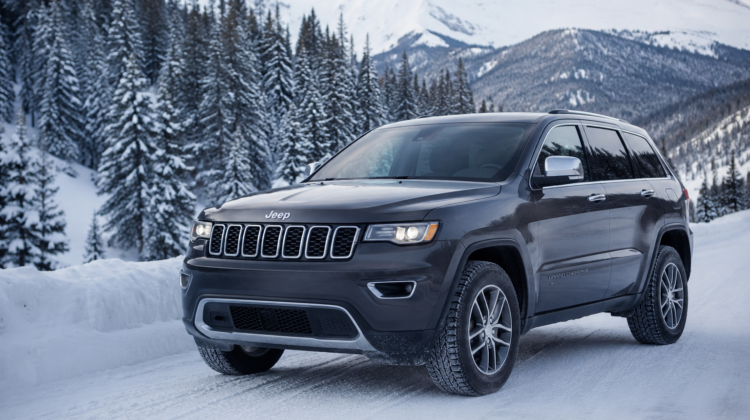
Best Jeep for Snow: Jeep Grand Cherokee
If your priority is snowy roads, winter commuting, highway driving, and comfort, the Jeep Grand Cherokee is arguably the best all-around Jeep for snow.
The Grand Cherokee has been offered with multiple 4×4 systems, including Quadra-Trac I, Quadra-Trac II, and Quadra-Drive II, depending on configuration. Its Selec-Terrain system can provide a dedicated Snow mode designed to optimize traction for winter conditions.
The latest Grand Cherokee also offers available Quadra-Lift air suspension, which can increase ride height when additional clearance is useful. Jeep lists five Selec-Terrain modes on applicable 2026 configurations: Auto, Sport, Rock, Snow, and Mud/Sand.
Why the Grand Cherokee works well in snow
- Available advanced 4×4 systems
- Dedicated Snow terrain mode on applicable models
- Available increased ground clearance
- Comfortable for daily winter commuting
- Strong highway manners
- Available three-row Grand Cherokee L for larger families
- More practical as an everyday vehicle than a highly modified off-road Jeep
For drivers who spend most of their time on paved roads but regularly deal with snow, the Grand Cherokee provides a particularly useful balance of winter capability and everyday comfort.
Jeep Wrangler: Best Jeep for Deep Snow and Unplowed Roads?
The Jeep Wrangler is another excellent winter vehicle, especially for drivers who want a Jeep that can handle both snow-covered roads and off-road terrain.
Its traditional 4×4 layout, high ground clearance, short overhangs, and rugged construction make the Wrangler well suited to difficult terrain. That capability becomes particularly useful when snow isn’t just covering the road but has accumulated deeply or roads haven’t been cleared properly.
A Wrangler can be a great choice for:
- Rural winter roads
- Deep snow
- Mountain roads
- Snow-covered trails
- Unplowed driveways
- Drivers who also want serious off-road capability
The tradeoff is that the Wrangler isn’t necessarily the best choice for every winter commuter. A Grand Cherokee may be more comfortable and easier to live with during long highway drives.
Wrangler Rubicon vs. regular Wrangler for snow
It’s easy to assume that the most off-road-focused Wrangler must automatically be the best Jeep for snow.
Not necessarily.
The Rubicon’s additional off-road hardware is extremely valuable when you’re dealing with difficult terrain, but a driver who primarily travels on maintained snowy roads may not need all of that equipment.
For everyday winter driving, tires and the appropriate 4×4 system can matter more than having the most extreme off-road trim.
Jeep Gladiator: A Good Jeep for Snow?
The Jeep Gladiator is worth considering for drivers who want the Wrangler’s open-air, off-road character but also need a pickup bed.
Its 4×4 capability and relatively high ground clearance make it suitable for winter conditions, particularly when equipped with appropriate tires.
The Gladiator makes the most sense for someone who needs:
- A pickup bed
- 4×4 capability
- Off-road ability
- Winter utility
- Space for equipment or outdoor gear
However, its pickup-truck layout means it doesn’t behave exactly like an SUV in every winter situation. As with any pickup, managing traction and load distribution is important, particularly on slippery surfaces.
Jeep Compass: A Practical Snow Option
For buyers who don’t need the size or extreme off-road capability of a Wrangler, the Jeep Compass can be a practical option for winter driving.
Depending on configuration and market, the Compass can offer all-wheel-drive capability and terrain-management features intended to improve performance on slippery surfaces.
It’s especially appealing to drivers who want:
- A smaller Jeep
- Easier city driving
- Better maneuverability
- Lower overall size than a Grand Cherokee or Wrangler
- Winter capability without a highly rugged off-road setup
For typical urban or suburban snow, a properly equipped Compass can make plenty of sense.
Jeep Grand Cherokee vs. Jeep Wrangler for Snow
So, which one should you choose?
| Category | Grand Cherokee | Wrangler |
|---|---|---|
| Daily winter commuting | Excellent | Very Good |
| Highway driving | Excellent | Good |
| Deep snow | Excellent | Excellent |
| Unplowed roads | Very Good | Excellent |
| Off-road snow | Very Good | Excellent |
| Ride comfort | Excellent | Good |
| Ground clearance | Excellent | Excellent |
| Family practicality | Excellent | Good |
| Outdoor/off-road use | Excellent | Excellent |
Choose the Grand Cherokee if:
You want a Jeep primarily for daily driving, highway travel, family use, and snowy roads.
Choose the Wrangler if:
You expect to encounter deep snow, rough terrain, mountain roads, or unplowed surfaces and want stronger off-road capability.
There isn’t one Jeep that is perfect for every winter driver. The best Jeep for snow depends heavily on where and how you drive.
Are Jeeps Good in Snow?
Yes, many Jeep models can perform very well in snow, but the vehicle alone doesn’t determine winter performance.
A Jeep with 4WD and poor tires can be less effective in winter than a properly equipped vehicle with excellent winter tires.
For that reason, don’t evaluate a used Jeep solely by its model, trim level, or 4×4 badge.
When shopping for a winter-ready Jeep, inspect:
- Tire type and condition
- Remaining tread depth
- 4×4 operation
- Brakes
- Battery condition
- Cooling system
- Suspension components
- Windshield wipers and defroster
- Exterior lighting
- Undercarriage for rust or damage
This becomes particularly important when you’re purchasing an older Jeep that has spent several winters in areas where roads are heavily salted.
The Most Important Upgrade for a Jeep Used in Snow
If you only make one winter-focused improvement, pay close attention to the tires.
Dedicated winter tires are designed specifically for cold-weather performance, while some all-terrain and all-weather tires can provide a useful compromise for drivers who also spend time off-road.
The right choice depends on your climate.
For frequent snow and ice
Consider dedicated winter tires.
For mixed winter and off-road driving
A snow-rated all-terrain tire may be a better compromise.
For mild winters
A quality all-season or all-weather tire may be sufficient, depending on your local conditions.
For example, current tire listings for the Grand Cherokee include all-terrain options marketed for severe-snow traction as well as dedicated winter tires.
The most important thing is to choose a tire appropriate for the conditions you actually encounter.
Is 4WD Enough for Snow?
No.
This is one of the biggest misconceptions about winter driving.
4WD helps a vehicle accelerate through low-traction conditions, but it doesn’t eliminate the limitations of tires, braking, road conditions, or driver behavior.
When braking on ice or packed snow, the tires still need to generate enough grip to stop the vehicle.
That’s why the ideal winter setup combines:
4×4/AWD + appropriate tires + good vehicle maintenance + sensible driving.
Don’t use the extra traction of a 4×4 system as an excuse to drive faster than conditions allow.
Tips for Driving a Jeep in Snow
Even the best Jeep for snow can become difficult to control if it’s driven aggressively on slippery roads.
Follow these basic winter-driving practices:
- Accelerate smoothly. Avoid sudden throttle inputs.
- Brake early. Give yourself significantly more stopping distance.
- Leave extra space. Increase the gap between your Jeep and the vehicle ahead.
- Use appropriate drive modes. Follow your owner’s manual for when to use Snow or other terrain settings.
- Clear snow from the vehicle. Remove snow from the roof, windows, lights, mirrors, and hood.
- Check tire pressure regularly. Cold temperatures can lower tire pressure.
- Carry winter essentials. A scraper, blanket, flashlight, charger, gloves, and basic emergency supplies can be useful.
- Know your route. Unplowed roads and steep grades can present very different challenges from ordinary city snowfall.
Most importantly, remember that winter traction is about control, not speed.
What Is the Best Jeep for Snow and Winter Driving?
For most people, the Jeep Grand Cherokee is the best overall choice for snow because it combines strong 4×4 capability with comfortable road manners and modern terrain-management technology.
The Jeep Wrangler takes the lead when the definition of “snow driving” includes deep snow, unplowed roads, steep terrain, and off-road use.
The Jeep Gladiator is a strong choice for drivers who need pickup-bed functionality, while the Jeep Compass can be a sensible option for drivers who want a smaller vehicle for everyday winter conditions.
Our overall picks
Best overall: Jeep Grand Cherokee
Best for deep snow and off-road use: Jeep Wrangler
Best Jeep pickup for snow: Jeep Gladiator
Best smaller Jeep for winter driving: Jeep Compass
But regardless of the model you choose, don’t overlook the tires. The best Jeep for snow is only as capable as its tires, drivetrain, and overall condition allow.
Looking for a Jeep for Winter?
Once you’ve decided which model fits your needs, the next step is finding the right vehicle and checking its condition carefully.
Whether you’re searching for a Wrangler, Grand Cherokee, Gladiator, Cherokee, Compass, or a classic Jeep, you can browse available Jeeps for sale and compare vehicles based on model, condition, year, and intended use.
A Jeep that is properly equipped and maintained can be an excellent companion through winter—but choosing the right configuration matters just as much as choosing the right badge.
Frequently Asked Questions
What is the best Jeep for snow?
For most drivers, the Jeep Grand Cherokee is the best all-around Jeep for snow because of its available 4×4 systems, Snow terrain mode on applicable configurations, comfort, and everyday practicality.
Is a Jeep Wrangler good in snow?
Yes. The Wrangler’s 4×4 capability, ground clearance, and off-road design make it particularly well suited to deep snow and unplowed terrain. Tires and driving technique remain critical.
Is the Jeep Grand Cherokee better than the Wrangler in snow?
It depends on the situation. The Grand Cherokee is generally the better choice for daily winter commuting and highway driving, while the Wrangler has an advantage when conditions become more rugged or off-road.
Do Jeeps need snow tires?
A Jeep does not automatically require dedicated snow tires, but winter tires can significantly improve traction and braking in cold, snowy conditions. Drivers in areas with frequent snow and ice should seriously consider them.
Is 4WD better than AWD in snow?
Neither is automatically “better” in every situation. The specific system, tires, vehicle setup, and road conditions all matter. A well-equipped AWD vehicle with excellent winter tires can perform very well, while a 4WD Jeep can provide valuable capability in deeper or more challenging conditions.
What Jeep has a Snow mode?
Applicable Jeep Grand Cherokee configurations feature Selec-Terrain with a dedicated Snow mode, alongside other selectable terrain settings.
What should I check when buying a used Jeep for snow?
Pay particular attention to the tires, 4×4 system, brakes, battery, suspension, rust, and overall maintenance history. A vehicle that has been neglected can be a poor winter choice regardless of how capable the model is on paper.
Final Thoughts
The search for the best Jeep for snow ultimately comes down to your driving environment.
If you primarily face snowy commutes, highways, and family travel, start with the Grand Cherokee. If winter means deep snow, backcountry roads, steep terrain, and serious off-road driving, the Wrangler deserves a close look.
And whichever Jeep you choose, invest as much attention in the tires and maintenance as you do in the 4×4 system. That’s where much of your real-world winter performance comes from.
