Jeep Wrangler Oil Capacity: How Many Quarts Does Your Wrangler Need?
Knowing the correct Jeep Wrangler oil capacity is essential before you start an oil change. The answer depends on your Wrangler’s model year and engine. A 2016 JK with the 3.6L Pentastar does not take the same amount of oil as a newer JL, for example.
In most modern Wranglers, the answer is often 5 quarts with a new filter—but there are important exceptions. Older JK models, EcoDiesel models, and the Rubicon 392 have different capacities.
This guide breaks down Jeep Wrangler oil capacity by engine and generation and explains how to avoid the common mistake of overfilling or underfilling your engine.
Quick Answer: Jeep Wrangler Oil Capacity
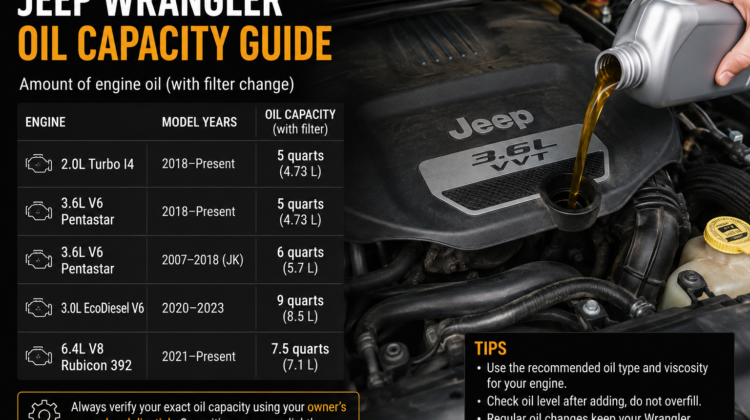
Here is a general reference for common U.S.-spec Jeep Wrangler engines:
| Engine | Typical Model Years | Oil Capacity With Filter |
|---|---|---|
| 3.6L V6 JK | 2007–2018 | 6 quarts (5.7 L) |
| 2.0L Turbo JL | 2018–present | 5 quarts (4.73 L) |
| 3.6L V6 JL | 2018–present | 5 quarts (4.73 L) |
| 3.0L EcoDiesel JL | 2020–2023 | 9 quarts (8.5 L) |
| 6.4L V8 Rubicon 392 | 2021–present | 7.5 quarts (7.1 L) |
Important: Capacities can vary depending on the exact model year, engine, market, and service procedure. Always use your owner’s manual and dipstick as the final authority for your specific Jeep.
For example, official 2026 Wrangler specifications list 5 quarts with filter for both the 2.0L and 3.6L engines and 7.5 quarts for the 6.4L V8.
Jeep Wrangler Oil Capacity by Generation
Jeep Wrangler JK Oil Capacity (2007–2018)
Most U.S.-spec JK Wranglers equipped with the 3.6L Pentastar V6 use approximately 6 quarts of engine oil with a filter change.
That applies to both:
- Two-door Wrangler models
- Four-door Wrangler Unlimited models
The number of doors doesn’t change the engine’s oil capacity. What matters is the engine installed under the hood.
The factory 2016 and 2018 Jeep Wrangler documentation lists 6 quarts for the 3.6L engine with the filter.
Jeep Wrangler JL Oil Capacity (2018–Present)
The newer JL generation introduced several engines, so there is no single answer to the Jeep Wrangler oil capacity question.
2.0L Turbo Four-Cylinder
The 2.0L turbocharged engine typically requires:
5 quarts (4.73 liters) with a filter change
This engine is found in standard JL Wranglers and the 4xe powertrain.
3.6L Pentastar V6
The newer JL version of the 3.6L Pentastar generally requires:
5 quarts (4.73 liters) with a filter change
This is different from the older JK’s commonly specified 6-quart capacity, which is why checking your generation is important.
3.0L EcoDiesel
The Wrangler’s 3.0L EcoDiesel requires substantially more oil:
9 quarts (8.5 liters) with a filter
The 2023 owner documentation lists 5 quarts for the 2.0L and 3.6L gasoline engines and 9 quarts for the 3.0L diesel.
6.4L V8 Rubicon 392
The high-performance Wrangler Rubicon 392 has the largest capacity among current gasoline Wranglers:
7.5 quarts (7.1 liters) with a filter
Official 2024 and 2026 Wrangler specifications list the 6.4L at 7.5 quarts.
Why Does the Same 3.6L Engine Have Different Capacities?
This can confuse a lot of Jeep owners.
You may see a 3.6L Wrangler listed with 6 quarts in one guide and 5 quarts in another. The reason is that the engine evolved between generations.
In simple terms:
- Older JK 3.6L models: commonly listed at 6 quarts
- Newer JL 3.6L models: commonly listed at 5 quarts
Never assume that every Wrangler with the same engine displacement uses the same amount of oil.
What Oil Should You Use in a Jeep Wrangler?
Oil capacity and oil type are two different specifications. You need to get both right.
Common examples include:
- Older JK 3.6L: commonly specified with 5W-20 in factory documentation
- JL 3.6L: commonly specified with full synthetic 0W-20
- JL 2.0L Turbo: commonly specified with full synthetic 5W-30
- Rubicon 392 6.4L: commonly specified with full synthetic 0W-40
- Diesel models: require diesel-specific oil meeting the appropriate Jeep/FCA specifications
Jeep’s published specifications for newer models list different oil requirements by engine, so don’t choose an oil solely because the viscosity worked in a previous Wrangler.
How to Change the Oil in a Jeep Wrangler
If you’re doing the job yourself, follow this basic process.
1. Confirm Your Engine
Check your:
- Owner’s manual
- VIN information
- Engine badge or label
- Under-hood emissions label
This ensures you buy the correct oil and filter.
2. Warm the Engine Briefly
Allowing the engine to warm up slightly can help the oil flow more easily. Don’t begin the service with an excessively hot engine, as hot oil can cause serious burns.
3. Drain the Old Oil
Position a suitable drain pan under the oil pan and remove the drain plug.
Allow the oil to drain completely.
4. Replace the Oil Filter
Install the correct replacement filter and lubricate the new filter seal if applicable.
Be careful not to overtighten it.
5. Start Below the Maximum Capacity
This is one of the most important steps.
Rather than immediately pouring in the full listed Jeep Wrangler oil capacity, start slightly below the specification.
For example, if your engine requires 5 quarts:
- Add approximately 4.5 quarts.
- Start the engine briefly.
- Check for leaks.
- Shut the engine off.
- Allow the oil to settle.
- Check the dipstick.
- Add oil gradually until the level is correct.
The dipstick matters more than blindly assuming the entire bottle must go into the engine.
What Happens If You Overfill the Oil?
Adding too much oil can be just as problematic as running the engine low.
Overfilling may lead to:
- Excessive crankcase pressure
- Oil aeration or foaming
- Increased oil consumption
- Seal problems
- Catalytic converter damage
- Engine performance issues
If you accidentally add a small amount too much, don’t simply ignore it. Check the dipstick and remove excess oil if the level is clearly above the maximum mark.
What Happens If You Don’t Add Enough Oil?
Low oil levels can create equally serious problems.
Possible consequences include:
- Reduced lubrication
- Increased engine wear
- Higher operating temperatures
- Valvetrain noise
- Oil pressure warnings
- Severe engine damage in extreme cases
That’s why it is wise to keep the oil level within the safe range rather than treating the capacity figure as an approximate guess.
How Often Should You Check Your Jeep Wrangler’s Oil?
A good habit is to check the level:
- Before a long road trip
- After extended off-road driving
- After towing
- Every few weeks during regular use
- If you notice an oil warning light
- If you suspect a leak
Off-road driving can expose a Wrangler to steep angles, impacts, mud, water, and high temperatures. A quick check under the hood after a demanding trip is never a bad idea.
Common Jeep Wrangler Oil Capacity Mistakes
Assuming Every Wrangler Takes 5 Quarts
This is true for many modern 2.0L and 3.6L models, but not for every Wrangler.
Older JKs, diesel Wranglers, and the Rubicon 392 require different amounts.
Ignoring the Oil Filter Change
Capacity is usually listed with the filter replaced. If you aren’t changing the filter, the actual refill amount may differ.
For a proper oil service, replacing the filter at the recommended interval is generally the safer approach.
Adding the Entire Capacity Without Checking the Dipstick
A printed capacity is a reference, not a substitute for checking the actual oil level.
Always verify the final level after the engine has run and the oil has settled.
Using the Wrong Oil Viscosity
The right amount of the wrong oil is still the wrong service.
Check the factory recommendation for your specific engine and model year.
Frequently Asked Questions About Jeep Wrangler Oil Capacity
How many quarts does a Jeep Wrangler take?
It depends on the engine. A modern 2.0L or 3.6L JL typically takes 5 quarts, while an older 3.6L JK may take 6 quarts. The 3.0L EcoDiesel takes more, and the Rubicon 392 requires 7.5 quarts.
Does a Jeep Wrangler take synthetic oil?
Many modern Wrangler engines are specified for full synthetic oil. Always check your owner’s manual for the exact viscosity and required oil standard.
Can I use 5W-30 instead of 0W-20?
You should use the oil viscosity and specification recommended for your exact engine. Viscosity is not interchangeable simply because both oils are synthetic.
Does the Jeep Wrangler 4xe use engine oil?
Yes. The 4xe combines electric and gasoline power, but it still has a combustion engine that requires regular oil changes and proper maintenance.
Looking for a Jeep With the Engine You Want?
Whether you’re shopping for a turbocharged JL, a classic JK, a diesel model, or a powerful Rubicon 392, the engine under the hood should be part of your buying decision.
Browse the latest Jeeps for sale to compare available Wrangler models, trims, engines, mileage, and pricing.
Final Thoughts
The correct Jeep Wrangler oil capacity depends primarily on the generation and engine. That’s why a simple search for “How much oil does a Jeep Wrangler take?” can produce different answers.
The safest approach is simple:
- Identify your exact Wrangler engine.
- Check the owner’s manual.
- Confirm the specified oil type and viscosity.
- Add slightly less than the stated capacity initially.
- Use the dipstick to verify the final level.
For many modern Wranglers, the answer is 5 quarts with a new filter. But for an older JK, EcoDiesel, or Rubicon 392, using the wrong capacity could lead to overfilling or underfilling.
A few minutes spent checking the correct specification can help keep your Wrangler running properly for years of daily driving, trail adventures, and everything in between.
