Jeep Wrangler Breakover Angle: What It Means and How to Improve It
When taking your Jeep Wrangler off-road, ground clearance is only part of the equation. You also need to consider how well your vehicle can travel over rocks, steep ridges, uneven trails, and other obstacles without scraping its undercarriage. This is where the Jeep Wrangler breakover angle becomes important.
Whether you’re driving a two-door Wrangler through rocky terrain or taking a four-door Unlimited across challenging trails, understanding your vehicle’s breakover angle can help you make better decisions about off-road routes, tire sizes, and suspension upgrades.
In this guide, we’ll explain what the breakover angle means, how it affects off-road performance, which Wrangler configurations offer better clearance, and what modifications can help improve it.
What Is the Jeep Wrangler Breakover Angle?
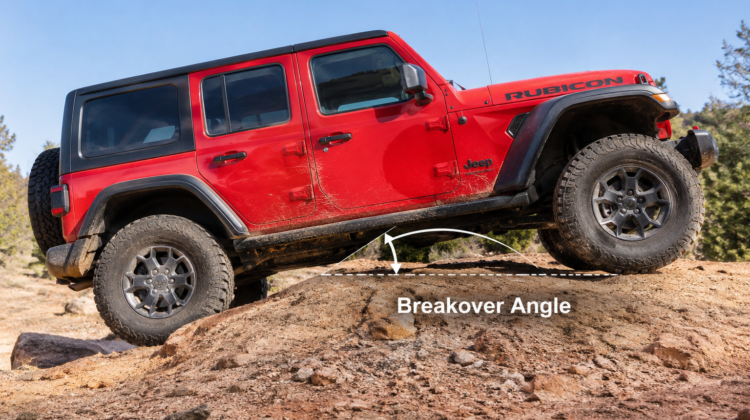
The Jeep Wrangler breakover angle is the maximum angle of a ridge or obstacle that your vehicle can drive over without the middle portion of its underbody making contact with the ground.
Imagine driving toward a steep, raised section of a rocky trail. Your front tires climb the obstacle, but as the middle of your Jeep reaches the highest point, the underside may touch the ground before the rear tires can climb over it.
This situation is commonly called high-centering.
A larger breakover angle generally means your Jeep can cross steeper obstacles without getting stuck on its undercarriage.
Several factors influence this measurement:
- Ground clearance: The distance between the lowest point of your vehicle’s underbody and the ground.
- Wheelbase: The distance between the front and rear axles.
- Tire diameter: Larger tires can increase the distance between the vehicle’s underbody and the ground.
- Suspension height: A properly designed suspension lift can provide additional clearance.
- Vehicle configuration: Two-door and four-door Wrangler models have different dimensions that affect their breakover angles.
In simple terms, a Jeep with greater ground clearance and a shorter wheelbase generally has an advantage when crossing sharp ridges.
Jeep Wrangler Breakover Angle by Model and Trim
Not every Jeep Wrangler has the same breakover angle. Measurements vary depending on the model year, trim level, body configuration, factory tire size, and available equipment.
The following figures come from Jeep’s published 2025 and 2026 specifications.
| Jeep Wrangler configuration | Breakover angle |
|---|---|
| 2025–2026 Sport 2-door | 25.0° |
| 2025–2026 Sport 4-door | 20.3° |
| 2025–2026 Sahara 4-door | 21.0° |
| 2025–2026 Rubicon 2-door | 27.8° |
| 2025–2026 Rubicon 4-door | 22.6° |
| 2025–2026 Rubicon with optional 35-inch tires, 2-door | Up to 32.4° |
| 2025–2026 Rubicon with optional 35-inch tires, 4-door | Up to 26.7° |
Note: These are published configuration-specific figures, not universal measurements for every Wrangler. Actual specifications depend on equipment and model configuration.
One interesting detail is the difference between two-door and four-door models. The shorter two-door Wrangler generally has a better breakover angle than its four-door counterpart.
For example, the standard Rubicon has a published breakover angle of 27.8 degrees in its two-door configuration, compared with 22.6 degrees for the four-door model.
The optional 35-inch tire configuration can improve those figures considerably.
If off-road capability is your main priority, these differences are worth considering before purchasing a Wrangler.
Why Does Breakover Angle Matter When Off-Roading?
A Jeep Wrangler is designed to handle challenging terrain, but even a capable 4×4 has physical limitations.
Your breakover angle becomes particularly important when driving across obstacles where the center of the vehicle needs to clear a raised surface.
Here are some situations where it makes a difference.
1. Crossing Rocky Trails
Rocky trails often contain large stones, uneven surfaces, and elevated ridges. A Jeep with a poor breakover angle may get caught on a rock underneath the chassis.
Having a higher breakover angle helps reduce the risk of underbody contact.
However, this doesn’t mean you should drive directly over every obstacle. Choosing the correct tire placement and crossing angle is still important.
2. Climbing Over Steep Ridges
Some off-road trails have sharp transitions between uphill and downhill sections.
When your front tires reach the top of a ridge, the middle of your Jeep may still be approaching the highest point. If the breakover angle is insufficient, the undercarriage can make contact with the ground.
A higher breakover angle gives you more room to navigate these transitions.
3. Driving Through Uneven Terrain
Deep ruts, dirt mounds, and uneven trails can create situations where one section of your vehicle sits higher than another.
Your breakover angle helps determine whether the center of the Jeep can pass over these obstacles without bottoming out.
It works alongside suspension articulation, traction, and ground clearance to improve overall off-road performance.
Breakover Angle vs. Approach Angle vs. Departure Angle
These three measurements are often mentioned together when discussing Jeep Wrangler off-road capability. Although they’re related, each describes a different part of the vehicle.
| Measurement | What it measures | When it matters |
|---|---|---|
| Approach angle | Maximum angle the front can climb without contact | Driving onto steep inclines |
| Breakover angle | Maximum ridge angle the middle can cross without contact | Crossing rocks and raised obstacles |
| Departure angle | Maximum angle the rear can descend without contact | Driving off steep drops and inclines |
Understanding all three measurements gives you a better picture of your Jeep’s off-road capabilities.
For example, a Wrangler might have an excellent approach angle but a smaller breakover angle because of its longer wheelbase.
This is one reason why you shouldn’t evaluate an off-road vehicle based on a single specification.
How to Improve Your Jeep Wrangler Breakover Angle
If you regularly drive on rocky trails or challenging off-road routes, there are several modifications that can help improve your Wrangler’s breakover angle.
However, choosing the right upgrades is important. Not every modification delivers the same benefits.
1. Install Larger Tires
One of the most straightforward ways to increase ground clearance is by installing larger tires.
For example, upgrading from 32-inch tires to 35-inch tires increases the tire radius by approximately 1.5 inches.
This can provide additional clearance underneath the axles and chassis, depending on the vehicle’s configuration.
Before upgrading, consider:
- Tire clearance inside the wheel wells.
- Potential rubbing during suspension compression.
- Wheel offset and backspacing.
- Changes to gearing and acceleration.
- Whether your factory spare tire carrier can support the larger tire.
Larger tires can improve off-road capability, but they should be paired with appropriate supporting modifications.
2. Upgrade Your Suspension
A properly selected suspension lift can increase the distance between the chassis and the ground.
Popular options include:
- 2-inch suspension lift kits.
- 3-inch suspension lift kits.
- Long-arm suspension systems for more advanced off-road builds.
A suspension upgrade can also improve articulation when properly designed and installed.
Keep in mind that lifting your Jeep raises its center of gravity, which can affect stability, especially when driving across uneven slopes.
Choose a suspension system designed for your intended driving conditions rather than focusing exclusively on ride height.
3. Protect Your Underbody
Improving clearance is useful, but protecting vulnerable components is equally important.
Consider installing:
- Engine skid plates.
- Transmission skid plates.
- Transfer case skid plates.
- Heavy-duty rock sliders.
- Differential protection.
These components help protect important parts of your Jeep when you encounter rocks and other obstacles.
Skid plates do not necessarily improve the measured breakover angle. However, they can reduce the risk of damage when your undercarriage makes contact with the terrain.
4. Choose the Right Wheel and Tire Setup
Your wheels also play a role in how your tires fit and perform.
Incorrect wheel offset or backspacing can cause tire rubbing, particularly when using larger tires and upgraded suspension components.
Before choosing new wheels, make sure the setup is compatible with your Wrangler’s suspension, brakes, and tire dimensions.
A well-matched wheel and tire combination can help you get the most out of your suspension upgrade.
5. Avoid Carrying Unnecessary Weight
Additional weight can compress your suspension and reduce available clearance.
This is especially important for Jeep owners who carry camping equipment, recovery gear, roof racks, storage systems, and other accessories.
Organize your cargo and avoid carrying equipment you don’t need for the trip.
If you frequently travel with heavy equipment, consider whether your suspension setup is appropriate for the additional load.
Two-Door vs. Four-Door Jeep Wrangler: Which Is Better for Breakover Angle?
If you’re choosing between a two-door Wrangler and a four-door Unlimited, the breakover angle is an important specification to consider.
The two-door Wrangler has a shorter wheelbase, which generally gives it an advantage when crossing steep ridges and uneven obstacles.
The four-door Wrangler, on the other hand, offers additional passenger space, cargo capacity, and practicality for longer trips.
Here’s a quick comparison:
| Feature | 2-Door Wrangler | 4-Door Wrangler |
|---|---|---|
| Wheelbase | 96.8 inches | 118.4 inches |
| Breakover angle (standard Rubicon) | 27.8° | 22.6° |
| Maneuverability | Generally better on tight trails | Requires more room |
| Passenger space | More limited | More spacious |
| Cargo practicality | Less cargo space | More cargo space |
For technical trail driving, the two-door Wrangler has a natural advantage because of its shorter wheelbase.
However, the four-door model remains a capable off-road vehicle, particularly when equipped with the Rubicon package and appropriate tire and suspension upgrades.
Your choice ultimately depends on how you plan to use your Jeep.
How to Drive Over Obstacles Without Bottoming Out
Even with a good breakover angle, your driving technique can make a significant difference.
Here are some practical tips when approaching steep ridges and rocky obstacles.
- Assess the obstacle first. Check the height, shape, and surrounding terrain before attempting to cross.
- Approach slowly. Avoid rushing toward an obstacle. A controlled approach gives you more time to adjust.
- Choose the correct line. Position your tires where they can climb the obstacle while keeping the center of the vehicle clear.
- Use low-range 4WD when appropriate. Low-range gearing provides better control when crawling over difficult terrain.
- Avoid sudden acceleration. Excessive throttle can cause wheel spin and make it harder to maintain traction.
- Use a spotter when necessary. Having someone outside the vehicle can help identify clearance issues that aren’t visible from the driver’s seat.
- Protect vulnerable components. If the obstacle is too high or risky, find another route rather than forcing your way through.
Remember that off-road driving requires more than just having the right equipment. Good judgment and controlled driving are just as important.
Is a Jeep Wrangler Rubicon Better for Breakover Angle?
The Rubicon is one of the most capable Wrangler configurations for serious off-road driving.
Depending on the model year and equipment, it offers features such as:
- Larger factory off-road tires.
- Increased ground clearance.
- Rock rails.
- Heavy-duty axles.
- Locking front and rear differentials.
- Electronic sway bar disconnect on equipped models.
These features work together to improve off-road performance.
The Rubicon also offers a higher factory breakover angle than several standard Wrangler configurations.
For example, the 2025–2026 Rubicon’s published breakover angle is 27.8 degrees for the two-door model and 22.6 degrees for the four-door model.
With the available 35-inch tire configuration, those figures can increase to 32.4 and 26.7 degrees, respectively.
If you regularly explore rocky trails, steep terrain, and challenging off-road routes, the Rubicon is worth considering.
However, a Sport or Sahara can also be a good starting point for owners who prefer a more customized build.
Frequently Asked Questions About Jeep Wrangler Breakover Angle
What is a good breakover angle for a Jeep Wrangler?
A breakover angle of 25 degrees or higher is a useful benchmark for many off-road applications, although the ideal measurement depends on the type of terrain you plan to drive.
A higher angle generally provides more flexibility when crossing steep ridges and raised obstacles.
Does a two-door Jeep Wrangler have a better breakover angle?
Generally, yes. Two-door Wrangler models have a shorter wheelbase than four-door Unlimited models, giving them an advantage when crossing sharp ridges.
The exact difference depends on the trim level, tire size, and model year.
Do bigger tires improve the Jeep Wrangler breakover angle?
Yes. Larger tires can increase ground clearance and improve the breakover angle.
However, the actual improvement depends on the vehicle’s suspension geometry, tire dimensions, and configuration.
Does a suspension lift improve breakover angle?
A suspension lift can increase chassis clearance and improve the breakover angle.
However, a lift alone doesn’t guarantee better off-road performance. Tire size, suspension geometry, wheelbase, and vehicle stability also matter.
What is the difference between breakover angle and ground clearance?
Ground clearance measures the vertical distance between the ground and the lowest point underneath your vehicle.
Breakover angle measures how steep a raised obstacle your vehicle can cross without the middle of its underbody touching the ground.
Both measurements are important when evaluating off-road capability.
Which Jeep Wrangler has the highest breakover angle?
Among the published 2025–2026 Wrangler configurations discussed in this guide, the two-door Wrangler with the available 35-inch tire package offers a breakover angle of up to 32.4 degrees.
Actual specifications depend on the model year and equipment.
Final Thoughts
The Jeep Wrangler breakover angle is an important specification for anyone interested in off-road driving. It determines how effectively your vehicle can cross steep ridges and raised obstacles without making contact with the undercarriage.
A shorter wheelbase, larger tires, appropriate suspension upgrades, and sufficient ground clearance can all contribute to better performance.
If you’re shopping for a Jeep Wrangler, take the time to compare different model years, trims, and configurations before making a decision.
You can explore available Jeeps for sale to compare different Wrangler models and find one that matches your driving needs, whether you’re looking for a daily driver, a weekend adventure vehicle, or a capable off-road build.
The right Wrangler isn’t necessarily the one with the biggest tires or tallest suspension. It’s the one with the right combination of capability, reliability, and practicality for the way you drive.

Leave a Reply