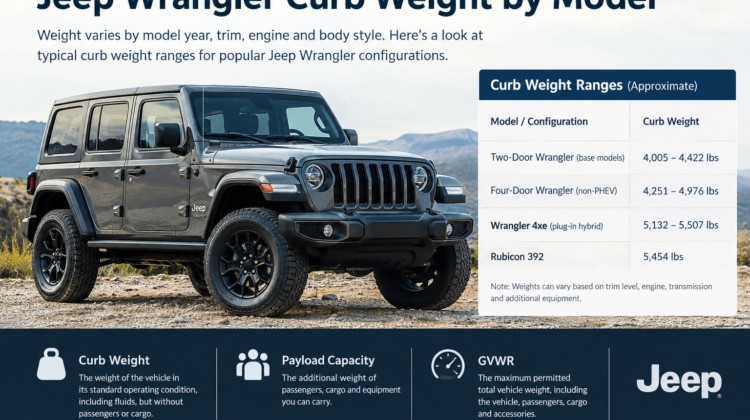
Jeep Wrangler Curb Weight by Model: 2-Door, 4-Door, Rubicon & 4xe
How much does a Jeep Wrangler weigh? The answer depends on the model year, body style, engine, transmission, trim level, and equipment. A lightweight two-door Sport can weigh considerably less than a four-door Rubicon 392 or a plug-in hybrid Wrangler 4xe.
Understanding Jeep Wrangler curb weight by model is useful when comparing vehicles, planning off-road upgrades, choosing a vehicle for everyday driving, or calculating how much passenger and cargo weight your Jeep can safely carry.
In this guide, we’ll compare published Wrangler weight figures, explain the difference between curb weight and payload, and show you how to find the exact specifications for the Jeep you’re considering.
Jeep Wrangler Curb Weight at a Glance
For the 2026 model year, Jeep publishes the following base curb-weight ranges:
| 2026 Jeep Wrangler configuration | Published base curb weight |
|---|---|
| Two-door Wrangler | 4,005–4,422 lbs |
| Four-door Wrangler, non-PHEV | 4,251–4,976 lbs |
The 2026 Wrangler’s published Gross Vehicle Weight Rating (GVWR) ranges from 5,100 to 6,250 pounds, depending on configuration. These figures come from Jeep’s official Wrangler FAQ. Individual specifications can vary by trim and installed equipment.
For the 2025 model year, Jeep lists these ranges:
| 2025 Jeep Wrangler configuration | Published base curb weight |
|---|---|
| Two-door Wrangler | 4,014–4,429 lbs |
| Four-door Wrangler | 4,287–4,976 lbs |
| Wrangler 4xe plug-in hybrid | 5,132–5,507 lbs |
| Wrangler Rubicon 392 | 5,454 lbs |
Source: Jeep’s official 2025 and 2026 Wrangler specifications and FAQs.
These figures show why it’s important to check the model year and powertrain rather than relying on one number for every Wrangler.
What Is Curb Weight?
Curb weight is the weight of a vehicle in its standard operating condition, including its usual operating fluids and fuel, but without passengers or cargo. The exact definition and testing convention can vary by published specification.
Curb weight is different from several other vehicle-weight measurements:
- Dry weight: Generally excludes some operating fluids; the exact definition varies by manufacturer.
- Curb weight: Represents the vehicle in its specified ready-to-operate condition.
- Payload capacity: The additional weight of occupants, cargo, and other loads the vehicle is rated to carry.
- GVWR: The maximum permitted total vehicle weight specified by the manufacturer.
- Gross combination weight rating (GCWR): The maximum rated combined weight of the vehicle and its loaded trailer.
For everyday use, curb weight helps you compare different Wrangler models. GVWR and payload are more important when determining how much equipment, luggage, passengers, and accessories you can add.
Jeep Wrangler Curb Weight by Body Style
Two-door Jeep Wrangler
The two-door Wrangler is the shorter, more compact version of the vehicle. It typically weighs less than a comparable four-door Wrangler, although the exact difference depends on the engine, trim, transmission, and equipment.
A two-door model may appeal to drivers who prioritize maneuverability on narrow trails, a shorter wheelbase, and a compact footprint.
It’s also worth considering how you intend to use the cargo area. The shorter body offers less room for luggage and camping equipment than the four-door model, so packing efficiently matters.
Four-door Jeep Wrangler Unlimited
The four-door Wrangler Unlimited has a longer wheelbase and a larger passenger compartment. Its additional body structure, doors, and equipment generally contribute to a higher curb weight.
The four-door configuration is often more practical for families, road trips, and overlanding setups that require extra storage space.
However, adding a roof rack, rooftop tent, steel bumpers, a winch, or larger tires increases the vehicle’s actual weight beyond its original published curb weight.
How Much Does a Jeep Wrangler Rubicon Weigh?
The Rubicon is designed with more specialized off-road equipment than a basic Wrangler configuration. Depending on the year and powertrain, that equipment can include upgraded axles, different tires, specialized four-wheel-drive hardware, and other components.
As a result, a Rubicon can weigh more than a similarly sized base model.
The Rubicon 392 is a particularly heavy example. Jeep lists its 2025 curb weight at 5,454 pounds.
Don’t assume every Rubicon has the same weight, though. A two-door Rubicon with one engine and transmission can weigh substantially less than a four-door Rubicon with another powertrain.
When comparing Rubicon models, verify:
- The model year.
- Whether it’s a two-door or four-door.
- The engine and transmission.
- Factory-installed packages.
- Any aftermarket accessories or modifications.
How Much Does a Jeep Wrangler 4xe Weigh?
The Wrangler 4xe is a plug-in hybrid, so its high-voltage battery and hybrid powertrain contribute additional mass.
For the 2025 model year, Jeep publishes a curb-weight range of 5,132 to 5,507 pounds for the Wrangler 4xe. The exact weight varies by configuration.
This extra weight doesn’t automatically make the 4xe a worse choice. It simply means you should compare the complete vehicle rather than assuming that all Wranglers weigh about the same.
If you’re evaluating a 4xe for camping, family travel, or off-road use, check its specific payload rating before adding heavy equipment.
What Affects Jeep Wrangler Curb Weight?
Several factors determine the weight of a particular Wrangler.
1. Engine and powertrain
Different engines, transmissions, and drivetrain components have different weights. A plug-in hybrid powertrain, for example, adds battery and electric-drive components.
2. Body style
A four-door Wrangler generally weighs more than a comparable two-door model because of its longer body and additional structure.
3. Trim level
Sport, Sahara, Rubicon, and Rubicon 392 models have different standard equipment and mechanical configurations.
4. Factory packages
Larger tires, upgraded wheels, additional protection, and other optional equipment can change the vehicle’s weight.
5. Aftermarket modifications
Common upgrades that add weight include:
- Steel front and rear bumpers
- Winches and recovery equipment
- Heavy-duty skid plates
- Oversized tires and aftermarket wheels
- Lift kits and reinforced suspension components
- Roof racks and rooftop tents
- Storage drawers and cargo systems
- Auxiliary batteries and electrical equipment
A heavily modified Wrangler may weigh several hundred pounds more than a comparable stock vehicle. The actual increase depends on the parts installed.
Jeep Wrangler Curb Weight vs. Payload Capacity
This distinction is especially important if you use your Wrangler for camping, overlanding, or hauling equipment.
Payload is the weight available for occupants, cargo, and applicable added equipment. It is not the same as towing capacity.
For example, imagine a Wrangler has a GVWR of 5,500 pounds and an actual ready-to-drive weight of 4,400 pounds.
The difference is:
5,500 − 4,400 = 1,100 pounds
That 1,100-pound difference is an illustrative calculation, not a specification for every Wrangler. Your actual available payload depends on the vehicle’s specific ratings and actual weight.
The available capacity must account for people, luggage, accessories, and other loads. Trailer tongue weight also counts against the tow vehicle’s payload when towing.
For the correct limit, check the certification label on the driver’s-side door area and the owner’s manual. For a modified Jeep, weighing the vehicle on a certified scale can help establish its actual loaded weight.
How Curb Weight Affects Jeep Wrangler Storage and Camping
If you plan to use your Wrangler for overlanding or weekend camping, curb weight is only the starting point.
Storage upgrades can add weight quickly, especially when you combine several accessories.
Consider these common additions:
- Roof racks and rooftop tents
- Cargo organizers and drawer systems
- Recovery boards, ropes, and tools
- Portable refrigerators
- Water containers
- Camping batteries and power stations
- Spare parts and emergency supplies
A practical approach is to list each accessory and its approximate weight before installing it. Include the weight of the mounting hardware, not just the main product.
Keep heavy equipment low
Whenever possible, place heavy equipment low and secure it properly. Loading heavy items high on a roof rack raises the vehicle’s center of gravity, which can affect handling and increase rollover risk.
Avoid treating cargo space as payload capacity
A Wrangler may have enough physical space for camping equipment without having enough remaining payload to carry it safely.
Check the vehicle’s weight ratings before loading it for a long trip.
Account for passengers and fuel
Your actual departure weight includes more than the vehicle itself. Passengers, cargo, accessories, and fuel all affect the load.
A careful packing plan helps you make better use of your storage space without exceeding the manufacturer’s limits.
How to Find the Exact Curb Weight of Your Jeep Wrangler
If you need an accurate figure for your own Jeep, follow these steps.
- Identify the model year. The specifications can change from year to year.
- Confirm the body style. Determine whether your Wrangler is a two-door or four-door model.
- Identify the trim and engine. Sport, Sahara, Rubicon, 4xe, and Rubicon 392 configurations may have different weights.
- Check the official specifications. Use the Jeep website, the original model-year brochure, or the owner’s documentation.
- Check the vehicle label. The door-jamb certification label provides important weight ratings, including GVWR. It does not necessarily state curb weight.
- Weigh a modified vehicle. If you’ve added heavy accessories, use a certified vehicle scale to establish its actual weight.
For U.S.-market vehicles, Jeep’s official specifications are a useful starting point. Always select the correct model year rather than assuming the current model’s figures apply to an older Wrangler.
Does a Heavier Jeep Wrangler Perform Worse Off-Road?
Not necessarily.
Vehicle weight is only one factor in off-road capability. Tire selection, ground clearance, suspension articulation, gearing, traction systems, and driver technique all matter.
A heavier Wrangler may carry more equipment and offer features that are useful for certain types of travel. On the other hand, additional weight can increase the demands placed on the brakes, suspension, tires, and drivetrain.
It can also increase the risk of getting stuck in soft terrain when combined with unsuitable tires or poor driving technique.
If you’re building an off-road Wrangler, consider the complete setup rather than choosing upgrades based on appearance alone.
Is a Lighter Jeep Wrangler Better for Daily Driving?
A lighter Wrangler can have advantages, including easier maneuverability in some situations and potentially lower demands on certain components. But weight alone doesn’t determine fuel economy, comfort, or reliability.
Engine choice, transmission, gearing, tires, aerodynamics, driving conditions, and maintenance all influence everyday performance.
The best Wrangler for daily use is the one that meets your needs while remaining practical to own and operate.
Frequently Asked Questions
What is the curb weight of a Jeep Wrangler?
The curb weight depends on the model year, trim, engine, transmission, and body style. For 2026, Jeep lists base curb-weight ranges of 4,005–4,422 pounds for two-door models and 4,251–4,976 pounds for four-door non-PHEV models.
Is a two-door Wrangler lighter than a four-door Wrangler?
Generally, yes, when comparing similar configurations. The four-door model has a longer body and additional structure, but the exact difference depends on the specific models being compared.
Why is the Jeep Wrangler 4xe heavier?
The 4xe uses a plug-in hybrid powertrain, including a high-voltage battery and electric-drive components. These add weight compared with many conventional gasoline-powered configurations.
Does a lift kit increase curb weight?
A lift kit and its associated components can increase vehicle weight, although the amount depends on the parts installed. Larger tires, wheels, bumpers, and other modifications can add further weight.
Where can I find my Jeep Wrangler’s GVWR?
Check the vehicle certification label, usually located on the driver’s-side door area, and consult the owner’s manual. GVWR is the maximum rated total vehicle weight, not the vehicle’s curb weight.
Does curb weight include passengers?
No. Curb weight does not include passengers or cargo. Those loads must be accounted for when determining whether the vehicle is within its rated weight limits.
Final Thoughts
Knowing the Jeep Wrangler curb weight by model makes it easier to compare trims, plan storage upgrades, and understand the limits of your vehicle.
A two-door Sport, four-door Unlimited, Rubicon 392, and Wrangler 4xe can have significantly different weights. The best approach is to check the exact model-year specifications and verify the weight ratings for the individual vehicle.
If you’re shopping for your next Wrangler, browse available Jeeps for sale and compare the year, trim, engine, and equipment before deciding which one fits your needs.
A little research up front can help you choose a Jeep that works for your daily driving, storage needs, and off-road plans.

Leave a Reply