Jeep Wrangler Payload Capacity by Year: Complete Guide to Weight Limits and Storage
The Jeep Wrangler is built for adventure, whether you’re driving through rugged trails, heading out for a weekend camping trip, or using it as your everyday vehicle. But before loading your Wrangler with camping equipment, luggage, tools, or off-road accessories, there’s one important specification you should understand: payload capacity.
Knowing the Jeep Wrangler payload capacity by year can help you determine how much weight your vehicle can safely carry. It also helps when choosing between different Wrangler models, especially if you plan to install aftermarket accessories or use your Jeep for overlanding.
In this guide, we’ll cover Jeep Wrangler payload ratings, explain what affects carrying capacity, and share practical storage tips to help you make the most of your available space without exceeding your vehicle’s weight limits.
What Is Jeep Wrangler Payload Capacity?
Payload capacity refers to the maximum additional weight a vehicle can carry while staying within its manufacturer’s Gross Vehicle Weight Rating (GVWR).
For a Jeep Wrangler, payload includes more than just the items stored in the cargo area. It accounts for virtually everything added to the vehicle after its curb weight is established.
This includes:
- Driver and passengers
- Luggage and personal belongings
- Camping and overlanding equipment
- Recovery tools and accessories
- Aftermarket bumpers and rock sliders
- Roof racks and rooftop tents
- Spare tires and other modifications
- Trailer tongue weight when towing
The basic payload calculation is:
Payload Capacity = GVWR − Curb Weight
For example, if your Wrangler has a GVWR of 5,500 pounds and a curb weight of 4,300 pounds, its theoretical payload capacity is 1,200 pounds.
However, the actual usable payload depends on the specific vehicle configuration. Always check the Tire and Loading Information label on the driver’s door pillar for the combined weight of occupants and cargo allowed for your particular Jeep.
Jeep Wrangler Payload Capacity by Year
Jeep Wrangler payload capacity varies by model year, trim, engine, transmission, and body configuration.
Two-door Sport models, four-door Unlimited models, Sahara trims, and Rubicon models can all have different weight ratings.
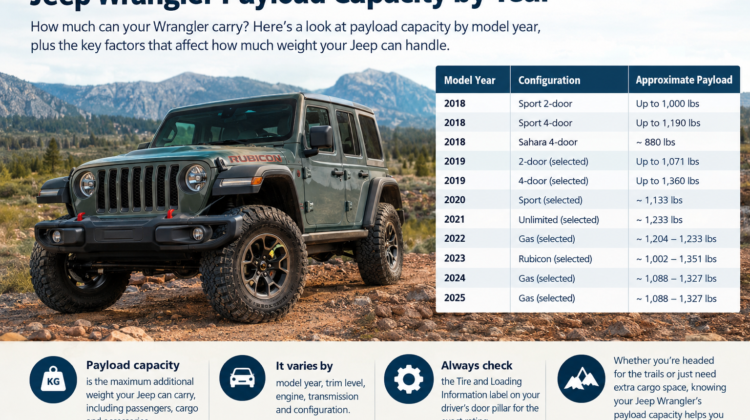
Below is a reference table showing representative published payload figures for selected Wrangler configurations.
| Model Year | Configuration | Approximate Payload |
|---|---|---|
| 2018 | Sport 2-door | Up to 1,000 lbs |
| 2018 | Sport 4-door | Up to 1,190 lbs |
| 2018 | Sahara 4-door | Approximately 880 lbs |
| 2019 | Selected 2-door configurations | Up to 1,071 lbs |
| 2019 | Selected 4-door configurations | Up to 1,360 lbs |
| 2020 | Selected Sport configurations | Approximately 1,133 lbs |
| 2021 | Selected Unlimited configurations | Approximately 1,233 lbs |
| 2022 | Selected gas-powered configurations | Approximately 1,204–1,233 lbs |
| 2023 | Selected Rubicon configurations | Approximately 1,002–1,351 lbs |
| 2024 | Selected gas-powered configurations | Approximately 1,088–1,327 lbs |
| 2025 | Selected gas-powered configurations | Approximately 1,088–1,327 lbs |
Important: These are representative figures, not universal ratings for every Wrangler within each model year. Actual payload can differ depending on factory equipment, engine, trim, and installed options. The manufacturer’s loading label on your specific vehicle takes priority.
Why Does Payload Capacity Change Between Model Years?
Jeep regularly updates the Wrangler’s engines, safety equipment, suspension components, and available features.
These changes can affect the vehicle’s curb weight and GVWR, resulting in different payload ratings.
For example:
- A Wrangler with additional factory equipment may weigh more than a basic Sport model.
- A Rubicon may have heavier off-road components and different weight specifications.
- A 4xe plug-in hybrid carries additional battery-system weight.
- A four-door Unlimited has a different weight configuration from a two-door Wrangler.
This is why checking the exact trim and configuration matters more than relying on a general model-year figure.
Jeep Wrangler Payload Capacity by Trim Level
The Wrangler lineup includes several trims designed for different types of drivers. Some prioritize affordability and everyday practicality, while others focus on off-road performance and additional equipment.
Here’s what to consider when comparing them.
Jeep Wrangler Sport
The Sport is generally one of the simpler Wrangler configurations. It offers the essential features needed for everyday driving and off-road adventures.
Its relatively straightforward equipment package can make it an attractive option for buyers who want to maximize practical carrying capacity without unnecessary accessories.
Jeep Wrangler Sport S
The Sport S adds convenience and comfort features over the standard Sport.
Depending on the selected options, additional equipment can increase curb weight and affect available payload.
Jeep Wrangler Sahara
The Sahara focuses more on comfort, appearance, and everyday usability.
Additional interior features and factory equipment can affect its payload rating, so buyers should compare the actual door-label specifications rather than assume it carries the same weight as a Sport.
Jeep Wrangler Willys
The Willys is designed with off-road-inspired features, including equipment that can vary by model year.
Its factory tires, wheels, and other accessories contribute to overall vehicle weight.
Jeep Wrangler Rubicon
The Rubicon is built for serious off-road driving.
Depending on the configuration, it may include:
- Heavy-duty axles
- Specialized suspension components
- Larger off-road tires
- Rock rails
- Locking differentials
- Additional underbody protection
These features improve off-road capability but can also reduce the remaining payload available for passengers and cargo.
Jeep Wrangler Rubicon 392
The Rubicon 392 features a powerful 6.4L HEMI V8 engine and additional performance equipment.
Its heavier powertrain and factory components make it particularly important to check the individual vehicle’s payload rating before planning a heavily equipped build.
Payload Capacity vs. Cargo Capacity: What’s the Difference?
Payload capacity and cargo capacity are related, but they measure different things.
Payload capacity measures weight. Cargo capacity measures available storage space.
A Jeep Wrangler Unlimited may have more room for luggage than a two-door Wrangler, but that doesn’t automatically mean it can carry an unlimited amount of equipment.
Consider the following comparison:
| Term | Meaning |
|---|---|
| Payload Capacity | Maximum additional weight the vehicle can carry |
| Cargo Volume | Available interior storage space |
| Curb Weight | Vehicle weight with standard equipment and operating fluids, generally without occupants or cargo |
| GVWR | Maximum allowable total vehicle weight |
| GAWR | Maximum allowable weight supported by an individual axle |
For Jeep owners interested in storage solutions, understanding this difference is essential.
You might have enough physical space to fit several camping boxes, coolers, and bags, but their combined weight could exceed your Wrangler’s available payload.
How to Calculate Your Jeep Wrangler’s Remaining Payload
Before loading your Jeep for a road trip, calculate how much weight you can safely carry.
Use this formula:
Remaining Payload = Maximum Payload − Occupants − Accessories − Cargo
Here’s a practical example.
Suppose your Jeep Wrangler has a payload capacity of 1,200 pounds.
You’re preparing for a weekend camping trip with the following equipment and passengers:
| Item | Weight |
|---|---|
| Driver | 180 lbs |
| Front passenger | 150 lbs |
| Two rear passengers | 300 lbs |
| Camping equipment | 120 lbs |
| Luggage | 100 lbs |
| Recovery equipment | 50 lbs |
| Total | 900 lbs |
Your remaining payload would be:
1,200 − 900 = 300 pounds
You would have approximately 300 pounds of remaining payload, assuming the vehicle’s axle weight limits are also respected.
Remember to account for aftermarket modifications and other equipment already installed on your Jeep.
Best Jeep Wrangler Storage Solutions Without Overloading Your Vehicle
A Jeep Wrangler offers plenty of opportunities for customization, but storage upgrades should be selected carefully.
The goal is to maximize usable space without adding unnecessary weight.
Here are several practical storage solutions worth considering.
1. Install a Rear Cargo Organizer
A rear cargo organizer helps keep smaller belongings in one place.
Instead of allowing tools, emergency supplies, and personal items to move around while driving, you can separate them into dedicated compartments.
Look for organizers that:
- Fit your Wrangler’s cargo dimensions
- Include secure mounting points
- Use lightweight materials
- Allow easy access to frequently used equipment
This is particularly useful for daily driving and weekend adventures.
2. Use Lightweight Storage Boxes
Heavy-duty metal storage boxes may look durable, but they can add considerable weight.
For most everyday camping setups, lightweight plastic storage containers are a practical alternative.
Consider using separate containers for:
- Cooking supplies
- Recovery equipment
- Emergency tools
- Clothing
- Food and personal belongings
Choose containers that fit securely and won’t slide around during off-road driving.
3. Consider a Roof Rack
A roof rack provides additional storage options for bulky equipment.
It can be useful for carrying items such as:
- Camping chairs
- Lightweight recovery equipment
- Sleeping bags
- Outdoor accessories
- Certain camping supplies
However, roof racks add weight and raise the vehicle’s center of gravity.
Always check the roof-load limits specified by the vehicle and rack manufacturers. Also account for the rack, mounting hardware, and everything carried on it.
4. Install a Tailgate Storage System
The Wrangler’s rear tailgate can be used for additional storage.
Tailgate-mounted MOLLE panels and accessory systems provide convenient locations for smaller equipment.
You can use them to organize:
- First-aid kits
- Flashlights
- Small tools
- Emergency supplies
- Compact recovery accessories
Keep the total weight within the tailgate and mounting system’s limits.
5. Use Seatback Storage Organizers
Seatback organizers are another useful option for keeping small belongings accessible.
They’re especially practical for families and Jeep owners who frequently travel with passengers.
You can store:
- Charging cables
- Maps
- Water bottles
- Small accessories
- Travel essentials
These organizers make better use of existing space without requiring bulky storage equipment.
Does Adding Jeep Accessories Reduce Payload Capacity?
Yes. Aftermarket accessories contribute to the total weight your Wrangler carries.
Even though modifications can improve performance, convenience, and off-road capability, they can reduce your available payload.
Here are some common modifications that add weight:
| Modification | How It Affects Payload |
|---|---|
| Steel front bumper | Reduces available payload |
| Rear steel bumper | Reduces available payload |
| Winch | Adds substantial front-end weight |
| Larger tires and wheels | Increases overall vehicle weight |
| Roof rack | Adds weight and affects roof loading |
| Rooftop tent | Adds weight and roof loading |
| Rock sliders | Reduces available payload |
| Rear tire carrier | Adds weight to the rear |
| Auxiliary battery | Reduces available payload |
For example, installing a steel bumper, winch, roof rack, and larger spare tire can consume a significant amount of your original payload capacity.
If you’re planning an overlanding build, weigh your Wrangler after installing the modifications.
A certified vehicle scale can help determine the actual front and rear axle weights.
What Happens If You Overload Your Jeep Wrangler?
Exceeding your Wrangler’s payload capacity can affect safety, handling, and mechanical reliability.
Here are some potential problems.
1. Reduced braking performance
Additional weight increases the force required to stop your vehicle. This can increase stopping distances and place additional stress on the braking system.
2. Suspension problems
Excessive weight can cause suspension components to operate beyond their intended limits, accelerating wear on springs, shocks, and bushings.
3. Poor handling
An overloaded Wrangler may experience excessive body roll, reduced steering response, and less predictable handling.
4. Increased tire stress
Carrying too much weight can increase tire temperatures and accelerate wear, particularly when tire pressures are not appropriate for the load.
5. Additional mechanical strain
Excessive weight can place additional stress on wheel bearings, axles, drivetrain components, and other mechanical systems.
Never assume that installing heavier-duty springs or a lift kit automatically increases your manufacturer’s GVWR or certified payload rating.
How to Choose the Right Jeep Wrangler for Camping and Overlanding
If you plan to use your Wrangler for camping or overlanding, payload capacity should be one of the specifications you consider before buying.
A typical adventure setup might include:
- Rooftop tent
- Portable refrigerator
- Water containers
- Recovery boards
- Camping chairs
- Cooking equipment
- Sleeping bags
- Tool kits
- Personal luggage
All these items contribute to your total vehicle weight.
Before purchasing a Wrangler, think about how many passengers you usually carry and how much equipment you intend to install.
A few useful buying considerations include:
- Check the door-label payload rating. Don’t rely solely on advertised maximum figures.
- Compare two-door and four-door configurations. Choose the body style that suits your passenger and storage requirements.
- Consider factory equipment. Heavier trims and additional options can reduce available payload.
- Plan for aftermarket modifications. Leave enough weight capacity for future upgrades.
- Consider axle ratings. Your total vehicle weight and individual axle loads must remain within their limits.
If you’re comparing different models, you can also browse available Jeeps for Sale to explore Wrangler configurations, mileage, features, and pricing.
Frequently Asked Questions About Jeep Wrangler Payload Capacity
1. How much weight can a Jeep Wrangler carry?
Many conventional Jeep Wrangler configurations have payload capacities ranging from approximately 880 to over 1,300 pounds.
However, the actual limit depends on the model year, trim, engine, body configuration, and factory equipment.
Check your vehicle’s Tire and Loading Information label for its exact occupant-and-cargo limit.
2. Does the Jeep Wrangler Unlimited have more payload capacity?
Not necessarily.
The four-door Wrangler Unlimited offers more passenger and cargo space, but its payload capacity depends on its GVWR and curb weight.
A larger interior does not automatically mean a higher weight limit.
3. Does a lift kit increase Jeep Wrangler payload capacity?
No. A lift kit does not automatically increase the manufacturer’s GVWR or payload rating.
Although some suspension upgrades can improve vehicle support, they do not change the certified weight limits.
4. Can I carry a rooftop tent on my Jeep Wrangler?
Yes, provided the roof rack and vehicle manufacturer limits allow it.
You must account for the combined weight of the rack, rooftop tent, mounting hardware, and any other roof-mounted equipment.
Also check the vehicle’s dynamic and static roof-load limits. Do not assume that a roof rack’s advertised capacity overrides the vehicle manufacturer’s restrictions.
5. Is payload capacity the same as towing capacity?
No. Payload capacity measures the additional weight carried by the vehicle itself.
Towing capacity measures the maximum allowable trailer weight under specified conditions.
However, trailer tongue weight is transferred to the towing vehicle and must be included when calculating its available payload.
6. Where can I find my Jeep Wrangler’s payload rating?
Look for the Tire and Loading Information label on the driver’s side door pillar.
It typically contains the statement:
“The combined weight of occupants and cargo should never exceed…”
This is the most important number to check before loading your Jeep.
7. Does the Jeep Wrangler 4xe have a different payload capacity?
Yes. The Wrangler 4xe uses a plug-in hybrid powertrain with additional battery and electrical components.
These components affect the vehicle’s weight and available payload. Always check the specifications for the exact model and trim.
Final Thoughts: Choose the Right Jeep Wrangler for Your Needs
Understanding your Jeep’s weight limits is essential whether you’re using it for everyday driving, camping, overlanding, or off-road adventures.
While the Jeep Wrangler payload capacity by year provides a useful starting point, remember that the actual carrying capacity depends on the specific vehicle’s trim, engine, factory equipment, and modifications.
Before purchasing a Wrangler or loading it with additional equipment, check its GVWR, axle ratings, and driver’s door loading label. A properly loaded Jeep will be safer, more predictable, and better prepared for your next adventure.
If you’re currently shopping for a Wrangler, explore our selection of Jeeps for Sale to find different Jeep models and configurations. Compare their specifications, mileage, and features to find a Jeep that fits your driving and adventure needs.

Leave a Reply