Jeep Renegade Years to Avoid: Which Model Years Should You Skip?
If you’re shopping for a used Jeep Renegade, knowing the Jeep Renegade years to avoid can help you avoid unexpected repair bills and reliability headaches.
The Renegade is an appealing choice for buyers who want a compact SUV with Jeep styling, available four-wheel drive, and useful ground clearance without moving up to a larger Wrangler or Grand Cherokee. However, some early model years have accumulated significantly more complaints and reliability concerns than others.
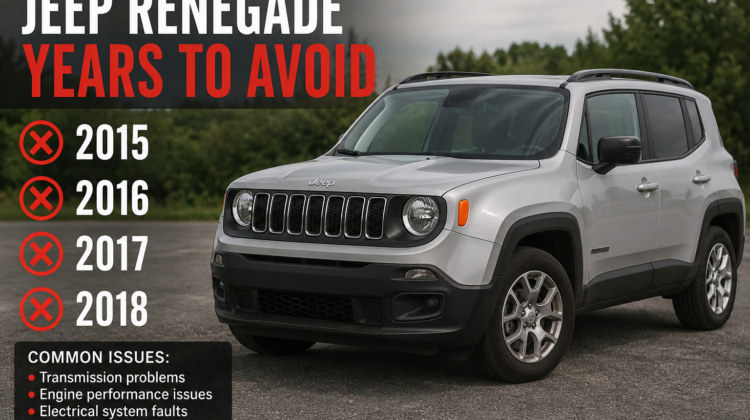
Based on available owner-complaint data, recall information, and reliability trends, 2015, 2016, 2017, and 2018 Jeep Renegade models deserve the most caution. That doesn’t mean every Renegade from these years is a bad vehicle, but buyers should inspect them carefully and verify that all applicable recalls and repairs have been completed.
Quick Answer: What Jeep Renegade Years Should You Avoid?
If you’re looking for the short version, these are the model years that deserve the most scrutiny:
- 2015 Jeep Renegade – The biggest concern, particularly for engine, transmission, and electrical problems.
- 2016 Jeep Renegade – Continued reports of transmission, electrical, and drivetrain-related problems.
- 2017 Jeep Renegade – Engine and fuel-system concerns make this year worth investigating carefully.
- 2018 Jeep Renegade – Complaints include engine and oil-consumption problems, although the overall picture is more mixed than the earliest models.
The 2015 model year stands out particularly strongly in owner complaint databases. CarComplaints currently lists it as the worst Renegade model year by overall complaints, while engine problems are its most significant category.
That doesn’t automatically make every 2015 Renegade a vehicle to reject. Condition, mileage, maintenance history, drivetrain, and recall completion all matter.
Why Is the 2015 Jeep Renegade Considered the Worst Year?
The 2015 Renegade was one of the first model years for the nameplate, and early production vehicles can sometimes have more issues as manufacturers work through new-platform problems.
Owner complaints associated with the 2015 Renegade include:
- Check-engine-light problems
- Engine performance issues
- Loss of engine power
- Hard or delayed transmission shifts
- Electrical problems
- Starting problems
- Brake complaints
- Various software and electronic issues
One of the recurring concerns is the 9-speed automatic transmission. Some owners have reported hesitation, hard shifting, delayed engagement, and other unusual transmission behavior.
If you’re considering a 2015 Renegade, don’t simply take it for a five-minute test drive around the dealership. Drive it long enough to evaluate cold starts, acceleration, shifting, braking, and highway behavior.
2016 Jeep Renegade: Another Year to Inspect Carefully
The 2016 Jeep Renegade improved in some areas, but it still appears frequently in reliability and complaint data.
Potential areas to investigate include:
- Transmission behavior – Pay attention to hesitation, harsh shifts, and delayed gear changes.
- Electrical systems – Test every switch, display, warning light, and electronic accessory.
- Engine performance – Watch for rough running, warning lights, unusual noises, or loss of power.
- Traction-control behavior – Make sure the system operates normally during the test drive.
- Maintenance history – A well-maintained example can be a much better proposition than a neglected vehicle.
There were also safety recalls affecting certain 2015–2016 Renegades. For example, one recall involved vehicles equipped with an optional trailer-hitch package where the hitch assembly could have been improperly fastened.
Always check the specific VIN rather than assuming a recall applies—or doesn’t apply—to every vehicle of the same model year.
2017 Jeep Renegade: Engine and Fuel-System Concerns
The 2017 Jeep Renegade is another year that deserves additional scrutiny when shopping for a used example.
Some complaint and recall data point toward engine, drivetrain, and fuel-system concerns.
For example, certain 2017–2018 Renegades equipped with the 2.4-liter engine were subject to a fuel-pump recall. Under certain conditions, a fuel-pressure problem could cause the engine to stall.
When inspecting a 2017 Renegade, look for:
- Check-engine lights
- Rough idle
- Hesitation during acceleration
- Stalling or near-stalling behavior
- Unusual engine noises
- Oil leaks
- Transmission hesitation
- Warning messages on the dashboard
A clean vehicle history report and documented maintenance are particularly valuable for this model year.
2018 Jeep Renegade: Better, But Not Problem-Free
The 2018 Jeep Renegade is sometimes overlooked because it’s newer than the first three model years. However, it still appears prominently in complaint databases.
One notable issue associated with this year is excessive oil consumption.
Before buying a used 2018 Renegade, ask the seller:
- How often does the vehicle require an oil top-up?
- Has the engine ever been repaired?
- Has the check-engine light appeared?
- Are there service records?
- Has the vehicle ever experienced overheating or loss of power?
- Are all recalls completed?
Don’t assume that a newer model year automatically means a trouble-free vehicle.
What About 2019 and Newer Jeep Renegades?
The reliability picture becomes more favorable as you move beyond the earliest Renegade model years.
Several sources show substantially lower complaint volumes for 2019 and later models compared with the 2015–2018 group. However, lower complaint numbers don’t mean zero problems.
A 2019, 2020, or 2021 Renegade can still have:
- Electrical faults
- Transmission problems
- Engine issues
- Suspension wear
- Air-conditioning problems
- Previous accident damage
- Poor maintenance history
In other words, buying a newer year is only part of the equation.
A properly maintained 2018 Renegade with excellent service records may be a better purchase than a neglected 2021 with accident history and incomplete maintenance.
The Jeep Renegade Engine Matters
One reason it’s difficult to create a simple “good year vs. bad year” list is that engine and drivetrain configuration matter.
Some Renegades were offered with different engine and drivetrain combinations depending on model year and market.
When shopping, identify:
- Engine size
- Transmission
- Front-wheel drive vs. 4×4
- Trim level
- Mileage
- Previous owners
- Maintenance history
Then research that specific configuration rather than relying exclusively on the model year.
How to Check a Used Jeep Renegade Before Buying
If you’ve found a Renegade from one of the Jeep Renegade years to avoid, don’t necessarily walk away immediately. Instead, perform a more thorough inspection.
1. Check the VIN
Run the vehicle identification number through the appropriate recall and vehicle-history databases.
This can help identify:
- Open recalls
- Previous accidents
- Title problems
- Mileage inconsistencies
- Previous ownership
- Reported damage
2. Review the Maintenance Records
Service records can tell you much more than a seller’s statement that the vehicle was “well maintained.”
Look for documentation showing:
- Regular oil changes
- Transmission servicing where applicable
- Brake maintenance
- Cooling-system maintenance
- Battery replacement
- Major repairs
- Recall completion
3. Take a Long Test Drive
Don’t limit the test drive to a parking lot.
Try:
- Stop-and-go traffic
- Highway speeds
- Hard acceleration
- Gentle acceleration
- Uphill driving
- Reversing
- Multiple transmission shifts
Pay attention to hesitation, vibration, clunking, warning lights, or abnormal shifting.
4. Get a Pre-Purchase Inspection
This is one of the smartest things you can do when buying an older used SUV.
Have an independent mechanic inspect:
- Engine
- Transmission
- Suspension
- Brakes
- Steering
- Cooling system
- Exhaust
- Electrical system
- Fluid leaks
- Undercarriage
A relatively inexpensive inspection can uncover problems that aren’t obvious during a test drive.
Are Jeep Renegades From the Bad Years Always Bad?
No.
This distinction is important.
“Years to avoid” doesn’t mean every vehicle from those years is defective. Reliability statistics are based on groups of vehicles and reported problems. Individual vehicles can vary significantly.
A Renegade with 90,000 miles and meticulous maintenance could potentially be a better purchase than one with 60,000 miles that has been neglected.
Consider the entire vehicle:
Model year + engine + mileage + maintenance + condition + accident history + recall status
That combination gives you a much better picture than the year alone.
Which Jeep Renegade Years Are Worth Considering?
If reliability is your primary concern, many buyers may want to focus their search on later-model Renegades, particularly 2019 and newer examples with strong maintenance histories.
Some data sources identify 2022 and 2023 as among the better-performing Renegade years based on reported complaints.
However, newer vehicles generally cost more, so there’s a trade-off between purchase price and potential maintenance risk.
If you’re shopping on a tighter budget, don’t automatically eliminate an older Renegade. Instead, compare the asking price against the likely cost of bringing the vehicle up to date mechanically.
Final Verdict: Jeep Renegade Years to Avoid
So, what are the Jeep Renegade years to avoid?
For buyers who want to minimize potential reliability problems, the 2015–2018 Renegade models deserve the most caution, with the 2015 model year standing out as the biggest concern in available complaint data.
That doesn’t mean these vehicles cannot be purchased. It means you should demand more from the vehicle before buying it:
- Complete maintenance records
- Clean vehicle history
- Verified recall completion
- A thorough mechanical inspection
- A proper test drive
- Evidence that major known issues have been addressed
For shoppers who want to reduce their risk, looking at 2019 and newer Renegades can be a sensible starting point, while newer 2022–2023 examples appear particularly attractive in available complaint data.
Ultimately, condition matters just as much as model year.
If you’re ready to compare available used Jeeps, take a look at the current Jeeps for Sale listings and compare different model years, mileage, trims, and prices before making a decision.
