The Shake That Scares You Straight: The Ultimate Jeep Wrangler Death Wobble Fix
If you own a solid-axle vehicle long enough, you might experience a terrifying rite of passage. You’re cruising down the highway at 60 mph, you hit a bridge expansion joint or a pothole, and suddenly—chaos. The steering wheel starts jerking violently back and forth, the front end feels like it’s about to disintegrate, and you’re white-knuckling the wheel while praying you can slow down without crashing.
Welcome to the “Death Wobble.”
It’s the boogeyman of the Jeep world. But here’s the good news: despite the name, it’s rarely fatal, and it is entirely fixable. You don’t need to sell your rig or start browsing jeeps for sale just yet (though we know the temptation is real when your daily driver tries to shake your fillings loose).
Here is your no-nonsense guide to diagnosing and fixing the wobble for good.
First: What Actually Is It?
Technically speaking, Death Wobble is a harmonic oscillation in your front suspension and steering components. In plain English? One part of your suspension is loose or worn out, allowing the wheel to wobble. That wobble transfers to the other wheel, creating a feedback loop that shakes the entire vehicle until you slow down almost to a stop.
It is not a braking issue. If your steering wheel shakes only when you hit the brakes, that’s a warped rotor. Death Wobble happens after hitting a bump or at specific speeds.
The “Band-Aid” Myth: Steering Stabilizers
Before we get into the fixes, let’s bust the biggest myth out there.
A new steering stabilizer will NOT fix Death Wobble.
If a mechanic tells you to just slap on a heavy-duty dual steering stabilizer to cure the shake, run away. A stabilizer is designed to dampen minor road feedback. If you have a violent wobble, something is loose. A strong stabilizer might mask the symptoms for a few weeks or months, but the underlying problem is still there, quietly destroying your other components.
Fix the loose part first. Then upgrade the stabilizer.
The Diagnosis: Finding the Culprit
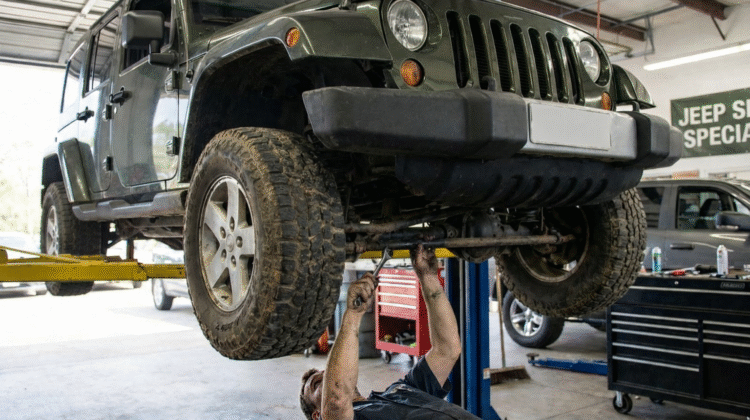
Grab a buddy, park your Jeep on level ground, and keep the engine off. You’re going to do a “Dry Steering Test.”
Have your friend sit in the driver’s seat and rock the steering wheel back and forth (about a quarter turn each way) continuously. While they do that, you need to crawl under the front end and watch every single joint. You are looking for play—movement where there shouldn’t be any.
1. The Track Bar (Public Enemy #1)
In 90% of cases, the front track bar is the villain.
- What to look for: Watch the mounting points on the frame side and the axle side. If the bar moves before the frame moves, you have a problem.
- The Fix:
- Loose Bolts: Sometimes, you just need to torque the bolts to spec (usually a massive 125 ft-lbs for many JK/JL models—check your manual).
- Worn Bushings: If the rubber is cracked or squished, replace the bar.
- Ovaled Holes: If the bolt was loose for too long, it might have wallowed out the mounting hole into an oval shape. You may need a weld-on washer kit to fix this.
2. Tie Rod Ends and Drag Link
While your buddy rocks the wheel, watch the joints connecting the steering bars.
- What to look for: Any “clunking” or vertical popping movement.
- The Fix: If the grease boots are torn or there is play in the joint, the entire end needs replacing.
3. Ball Joints
These hold your knuckles to the axle C’s.
- How to check: Jack up one front tire until it’s barely off the ground. Stick a pry bar under the tire and lift up.
- The Fix: If you hear a click or see significant movement, your ball joints are toast. Factory ball joints are known to wear out quickly once you add bigger tires. Upgrading to heavy-duty aftermarket ball joints is usually the best move here.
The Checklist for a Wobble-Free Ride
If you’ve checked the suspension and everything feels tight, but you’re still shaking, it’s time to look at the geometry and rolling stock.
- Tire Balance: You might just have thrown a wheel weight. A severely unbalanced tire can trigger a wobble that loose components would otherwise absorb. Rotate your tires front-to-back to see if the wobble changes.
- Alignment (Caster Angle): If you lifted your Jeep recently, your caster angle might be off. Insufficient caster makes the wheels flutter like a shopping cart with a bad wheel. You may need adjustable control arms or geometry correction brackets to get your flight path steady again.
When to Call it Quits?
Fixing Death Wobble is usually a matter of methodical diagnosis. Start with the track bar, move to the tie rods, check the ball joints, and verify your tire balance.
However, if you’re tired of the maintenance, the busted knuckles, and the constant “Jeep thing” problems, maybe it is time for a change. There is no shame in admitting you want a rig that rides smoother. You can always check out listings of jeeps for sale to find a newer model (the JL Wrangler has an updated steering box that handles these issues much better) or perhaps a Gladiator for a longer wheelbase and more stability.
But for those of us who love our current rigs? Tighten those bolts, check your bushings, and get back on the trail. The wobble is just another challenge to conquer.
