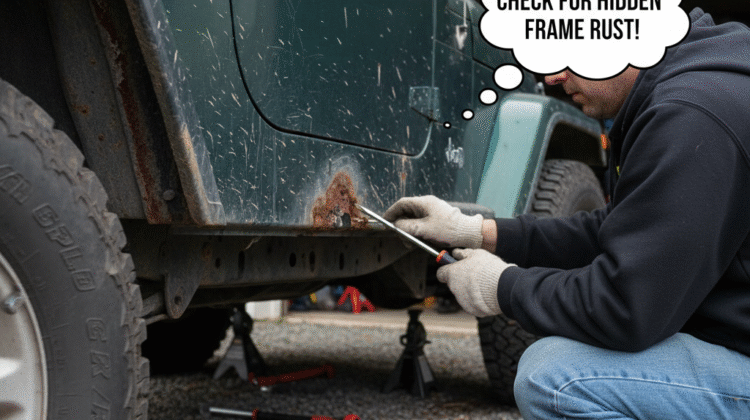
The #1 Deal-Breaker: How to Check for Frame Rust on a Used Jeep
So, you’re in the market for a Jeep. You’ve pictured it: doors off, top down, hitting a trail… or maybe just the speed bumps at the mall with authority. It’s an exciting feeling. But before you get lost in the dream, you need to face the one nightmare that can turn that dream into a financial money pit: Frame Rust.
Let’s be blunt: Rust is the cancer of all vehicles, and on a Jeep, it has a special appetite for the frame. A rusty frame isn’t a cosmetic issue; it’s a structural failure. It’s unsafe, incredibly expensive to fix (if it’s even possible), and it’s the single most important thing you need to check.
A shiny coat of paint and a clean interior mean nothing if the bones are rotten.
Don’t worry. You don’t need to be a master mechanic to spot a lemon. You just need to know where to look and what to bring.
Your Rust-Hunting Toolkit
Bring these few simple items. Trust me, you’ll look like a pro.
- A powerful flashlight (Your phone’s light is not good enough)
- A small hammer or the hard plastic handle of a screwdriver
- Safety glasses (Rust flakes in the eye? No thanks.)
- An old blanket, mat, or piece of cardboard to lie on
The 5-Step Frame Inspection That Will Save You Thousands
Get ready to get a little dirty. This 10-minute check separates the solid investments from the scrapyard-bound disasters.
1. Get Low and Look (The First Pass)
Don’t just crouch. Get on your back and slide under. Start at the front and visually inspect the entire length of both frame rails.
You’re looking for more than just color. You’re looking for texture.
- Surface Rust: This is common and often okay. It looks like a light, powdery-orange coating.
- Scale/Flaking Rust: This is bad. This is the “metal lasagna” layer—flaky, scaly, and bubbling under the paint.
- Fresh Paint/Undercoating: This is a massive red flag. A freshly painted black frame is almost always hiding something. The factory frame paint is thin; a thick, gooey, or rubbery coating is aftermarket. Be very, very suspicious.
2. The “Tap Test”: Listen for the Truth
This is where your hammer or screwdriver handle comes in.
- Put on your safety glasses.
- Tap along the frame rails, focusing on the areas below.
- Listen closely.
A solid frame will make a sharp, metallic “TINK! TINK! TINK!” sound.
A rotten frame will make a dull, soft, or crunchy “THUD” or “CRUNCH”. If your hammer tap sends flakes flying or, even worse, makes a new hole—run.
3. Focus on the “Hotspots” (Where Rust Hides)
Rust loves to hide in places where mud, salt, and water get trapped. Here are the critical checkpoints:
- Control Arm Mounts: Where the suspension arms bolt to the frame. These are under high stress and are a common failure point.
- Body Mounts (Outriggers): The brackets that connect the Jeep’s tub (body) to the frame.
- The “Hole” Problem: Shine your flashlight inside the oval drainage holes in the frame. This is where mud gets trapped and the frame rots from the inside out. What looks okay on the outside can be hollowed-out dust on the inside.
- Above the Skid Plates: The area above the transmission and transfer case skid plate is a notorious mud-and-water trap. It’s hard to see, so get your light in there.
- Rear Torque Boxes: On older TJs and YJs, the boxy frame section right in front of the rear wheels is a prime target.
4. Check for “Lipstick on a Pig”
As mentioned, fresh undercoating is a warning. Sellers will try to cover up rot to make a quick sale. Press your thumb hard against any suspicious-looking, freshly painted spots. Is it soft or “crispy” underneath? Try to (discreetly) flake a bit off with a fingernail or car key. If you see layered, chunky rust underneath that fresh paint, you have your answer.
5. Know When to Walk Away
Here’s the deal: when you’re browsing all the different jeeps for sale online, they all start to blend together. You’ll get excited. You’ll want the search to be over.
Do not let that excitement cloud your judgment.
A little bit of surface rust is a negotiating point. You can treat it and stop it.
But flaking, bubbling, or soft spots are a full-stop, walk-away-now deal breaker. It doesn’t matter how great the price is. It doesn’t matter if it has the “perfect lift” or new tires. There are thousands of other jeeps for sale that don’t have a compromised frame. Be patient and wait for one of those.
Final Verdict: Is it Rust or Just Patina?
| Type | How it Looks | What it Means |
| Surface Rust | Powdery, light orange/brown. Scrapes off to show solid metal. | Normal wear and tear. Can be easily treated and prevented. |
| Scale / Rot | Layered, flaky, bubbling, dark brown/black. | Structural failure. This is a “no-go.” The frame is compromised. |
| Fresh Paint | Thick, gooey, rubbery, or suspiciously clean and black. | Major Red Flag! Almost certainly hiding scale and rot. Proceed with extreme caution. |
A Jeep is one of the most fun vehicles you can ever own. But buying one with a rotten frame is the fastest way to ruin that fun. Take your time, do your inspection, and buy with your head, not just your heart. A solid frame is the only foundation worth building your adventure on.
